苯 (běn) means "Benzene" in Chinese. It has 8 strokes with the radical 艹.
Rated 3.7/5 in difficulty (challenging).
Appears in 3+ common words including 苯 (běn), 甲苯 (jiǎ běn), 苯环 (běn huán).
Due to its 8 strokes, Hanzi Writer's error detection shows 苯 requires focused practice — most learners need 10+ attempts for consistent accuracy.
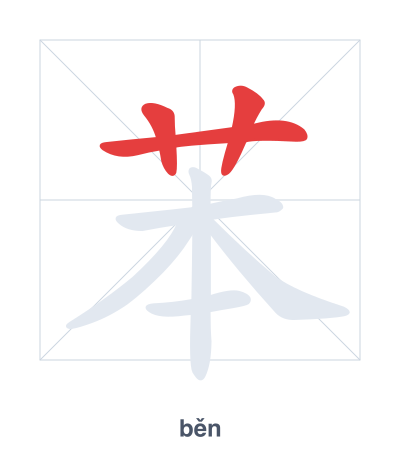
Open Hanzi Writer to see the animated stroke order and practice writing 苯 with real-time feedback.
The character 苯 (běn) is written with 8 strokes. Follow the standard Chinese stroke order: top to bottom, left to right, outside before inside. The radical 艹 is one of its key components.
Practice the correct stroke order with the Hanzi Writer app to see animated stroke-by-stroke guidance with real-time feedback.
苯 means Benzene.
The character 苯 is a phono-semantic compound: the grass radical (艹) signals a plant-related substance, while 本 (běn, 'root') provides the pronunciation and hints at the substance's origin—benzene was originally isolated from plant-based coal tar.
💡 Memory Tip: Picture a grass stem (艹) sprouting from a thick root (本) that reeks of sweet benzene fumes.
苯是一种化学物质。
běn shì yī zhǒng huà xué wù zhì
Benzene is a chemical substance.
甲苯常用于工业。
jiǎ běn cháng yòng yú gōng yè
Toluene is commonly used in industry.
这是苯环的结构。
zhè shì běn huán de jié gòu
This is the structure of a benzene ring.
Open Hanzi Writer to see the animated stroke order and practice writing 苯 with real-time feedback.
✨ Animated stroke order · Handwriting recognition · HSK-graded practice · Free to use
苯 has the radical 艹 (grass radical) on top, and 本 (běn, meaning "root" or "book") below. The grass radical hints that benzene is an organic compound originally derived from plant sources. The bottom part 本 provides the pronunciation běn and also suggests the "root" structure of the benzene molecule.