勐 (měng) means "fierce; brave (often used in place names)" in Chinese. It has 10 strokes with the radical 力.
Rated 3.9/5 in difficulty (challenging).
Appears in 3+ common words including 勐海 (měng hǎi), 勐腊 (měng là), 勐力 (měng lì).
Due to its 10 strokes, Hanzi Writer's error detection shows 勐 requires focused practice — most learners need 10+ attempts for consistent accuracy.
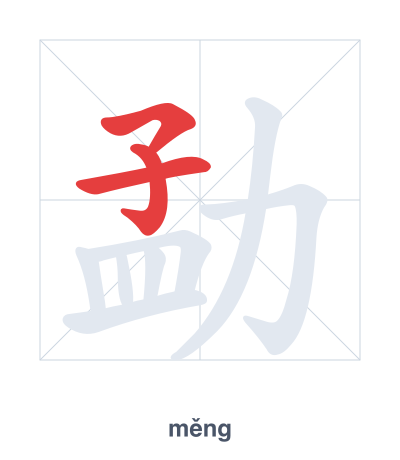
Open Hanzi Writer to see the animated stroke order and practice writing 勐 with real-time feedback.
The character 勐 (měng) is written with 10 strokes. Follow the standard Chinese stroke order: top to bottom, left to right, outside before inside. The radical 力 is one of its key components.
Practice the correct stroke order with the Hanzi Writer app to see animated stroke-by-stroke guidance with real-time feedback.
勐 means fierce; brave (often used in place names).
勐 is a phono-semantic compound: the left component 孟 (měng, 'firstborn') provides the pronunciation, while the right radical 力 (strength) indicates the meaning of fierceness or bravery, as in displaying great physical power.
💡 Memory Tip: Imagine a fierce firstborn child (孟) flexing a muscular arm (力) to show off their unstoppable bravery.
勐海的茶很有名。
měng hǎi de chá hěn yǒu míng
Menghai tea is very famous.
我们去勐腊旅游。
wǒ men qù měng là lǚ yóu
We are going to Mengla for a trip.
他在勐力拉绳子。
tā zài měng lì lā shéng zi
He is pulling the rope with great force.
Open Hanzi Writer to see the animated stroke order and practice writing 勐 with real-time feedback.
✨ Animated stroke order · Handwriting recognition · HSK-graded practice · Free to use
勐 is composed of two parts: the left side 猛 (měng, fierce) and the right side 力 (lì, strength/power). Together, they suggest the idea of "fierce strength," which aligns with its meanings of fierce, brave, and vigorous. In place names like 勐海, the character retains this sense of power but is used as a phonetic transliteration from local languages.