劾 (hé) means "Impeach; accuse" in Chinese. It has 8 strokes with the radical 力.
Rated 3.4/5 in difficulty (challenging).
Appears in 3+ common words including 弹劾 (tán hé), 劾查 (hé chá), 纠劾 (jiū hé).
Due to its 8 strokes, Hanzi Writer's error detection shows 劾 requires focused practice — most learners need 10+ attempts for consistent accuracy.
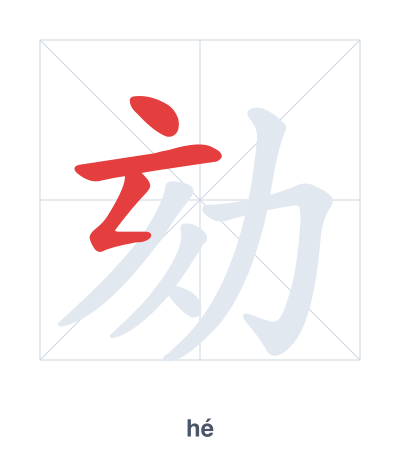
Open Hanzi Writer to see the animated stroke order and practice writing 劾 with real-time feedback.
The character 劾 (hé) is written with 8 strokes. Follow the standard Chinese stroke order: top to bottom, left to right, outside before inside. The radical 力 is one of its key components.
Practice the correct stroke order with the Hanzi Writer app to see animated stroke-by-stroke guidance with real-time feedback.
劾 means Impeach; accuse.
劾 is a phono-semantic compound: the left side 亥 (hài) suggests the pronunciation, while the right side 力 (power) implies using authority to bring charges. Originally, it conveyed the idea of 'to investigate and accuse with force'.
💡 Memory Tip: Imagine a powerful fist (力) smashing a pig (亥) in court, loudly impeaching it for corruption.
议会决定弹劾他。
yì huì jué dìng tán hé tā
The parliament decided to impeach him.
官员正在接受劾查。
guān yuán zhèng zài jiē shòu hé chá
The official is undergoing an investigation for misconduct.
法律可以纠劾不公。
fǎ lǜ kě yǐ jiū hé bù gōng
The law can investigate and impeach injustice.
Open Hanzi Writer to see the animated stroke order and practice writing 劾 with real-time feedback.
✨ Animated stroke order · Handwriting recognition · HSK-graded practice · Free to use
The character 劾 combines the left component 亥 (hài), which relates to "checking" or "verifying", with the right component 力 (lì), meaning "strength" or "power". Together, they suggest using official power to investigate and accuse someone, forming the meaning "impeach" or "accuse".