劵 (juàn) means "Tired; weary" in Chinese. It has 8 strokes with the radical 力.
Rated 3.4/5 in difficulty (challenging).
Appears in 3+ common words including 劳劵 (láo juàn), 疲劵 (pí juàn), 勤劵 (qín juàn).
Due to its 8 strokes, Hanzi Writer's error detection shows 劵 requires focused practice — most learners need 10+ attempts for consistent accuracy.
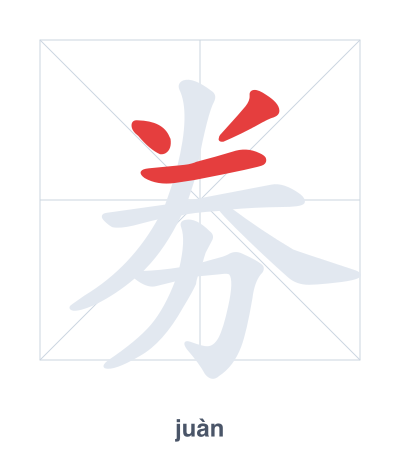
Open Hanzi Writer to see the animated stroke order and practice writing 劵 with real-time feedback.
The character 劵 (juàn) is written with 8 strokes. Follow the standard Chinese stroke order: top to bottom, left to right, outside before inside. The radical 力 is one of its key components.
Practice the correct stroke order with the Hanzi Writer app to see animated stroke-by-stroke guidance with real-time feedback.
劵 means Tired; weary.
Combine 卷 (scroll, suggesting curling up) with 力 (strength). The image is of using one's strength until curling up in exhaustion, meaning tired or weary.
💡 Memory Tip: A scroll (卷) is so heavy that you use all your strength (力) to lift it, leaving you utterly tired (劵).
身体感到劳劵。
shēn tǐ gǎn dào láo juàn
The body feels fatigued.
走了远路很疲劵。
zǒu le yuǎn lù hěn pí juàn
Walking a long distance is very tiring.
他做事勤劵。
tā zuò shì qín juàn
He works diligently.
Open Hanzi Writer to see the animated stroke order and practice writing 劵 with real-time feedback.
✨ Animated stroke order · Handwriting recognition · HSK-graded practice · Free to use
劵 has a top component 龹 (a form of 卷 meaning 'to roll') and the bottom radical 力 (strength). Together, they suggest that when strength is 'rolled up' or strained, a person feels tired.