骆 (luò) means "Camel (character)" in Chinese. It has 9 strokes with the radical 马.
Rated 4/5 in difficulty (challenging).
Appears in 3+ common words including 骆驼 (luò tuó), 骆驼毛 (luò tuó máo), 骆驼刺 (luò tuó cì).
Due to its 9 strokes, Hanzi Writer's error detection shows 骆 requires focused practice — most learners need 10+ attempts for consistent accuracy.
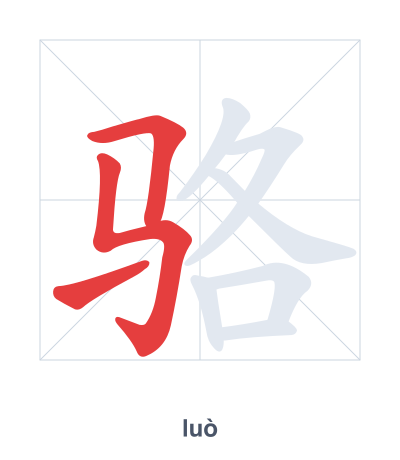
Open Hanzi Writer to see the animated stroke order and practice writing 骆 with real-time feedback.
The character 骆 (luò) is written with 9 strokes. Follow the standard Chinese stroke order: top to bottom, left to right, outside before inside. The radical 马 is one of its key components.
Practice the correct stroke order with the Hanzi Writer app to see animated stroke-by-stroke guidance with real-time feedback.
骆 means Camel (character).
骆 is a phono-semantic compound: the radical 马 (horse) indicates the animal class, while 各 (gè) provides the pronunciation. Historically, camels were seen as horse-like animals with distinctive humps, so the character uses the horse radical as a semantic clue.
💡 Memory Tip: Picture a horse (马) with a giant hump on its back shaped like the top part of 各, turning it into a camel.
沙漠里有很多骆驼。
shā mò lǐ yǒu hěn duō luò tuó
There are many camels in the desert.
这件衣服是骆驼毛做的。
zhè jiàn yī fú shì luò tuó máo zuò de
This garment is made of camel hair.
骆驼刺生长在荒漠中。
luò tuó cì shēng zhǎng zài huāng mò zhōng
Camel thorns grow in the desert.
Open Hanzi Writer to see the animated stroke order and practice writing 骆 with real-time feedback.
✨ Animated stroke order · Handwriting recognition · HSK-graded practice · Free to use
骆 is made of the radical 马 (horse) on the left and the phonetic component 各 (gè) on the right. The horse radical indicates that a camel is a large, riding animal similar to a horse. The right part 各 mainly provides the pronunciation luò, not the meaning.