雒 (luò) means "Black horse with a white mane; ancient name for Luoyang" in Chinese. It has 14 strokes with the radical 隹.
Rated 4.2/5 in difficulty (advanced).
Appears in 3+ common words including 雒阳 (luò yáng), 雒诵 (luò sòng), 雒马 (luò mǎ).
Due to its 14 strokes, Hanzi Writer's error detection shows 雒 requires focused practice — most learners need 10+ attempts for consistent accuracy.
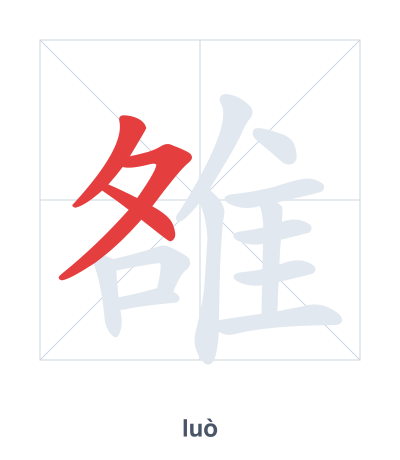
Open Hanzi Writer to see the animated stroke order and practice writing 雒 with real-time feedback.
The character 雒 (luò) is written with 14 strokes. Follow the standard Chinese stroke order: top to bottom, left to right, outside before inside. The radical 隹 is one of its key components.
Practice the correct stroke order with the Hanzi Writer app to see animated stroke-by-stroke guidance with real-time feedback.
雒 means Black horse with a white mane; ancient name for Luoyang.
| Character | 雒 |
| Pinyin | luò (luo) |
| Meaning | Black horse with a white mane; ancient name for Luoyang |
| Strokes | 14 |
| Radical | 隹 |
| Difficulty | 4.2/5 |
雒 combines the phonetic component 各 (originally meaning 'arrive' but here used for its sound) with the radical 隹 (a short-tailed bird). In ancient texts, it originally referred to a type of owl, but later it was borrowed to denote a black horse with a white mane and became the name of the city Luoyang.
💡 Memory Tip: Imagine each (各) bird (隹) is actually a black horse with a white mane, galloping across the ancient capital.
他住在雒阳。
tā zhù zài luò yáng
He lives in Luoyang.
大家都在雒诵。
dà jiā dōu zài luò sòng
Everyone is reciting aloud.
这是一匹雒马。
zhè shì yì pǐ luò mǎ
This is a black horse with a white mane.
Open Hanzi Writer to see the animated stroke order and practice writing 雒 with real-time feedback.
✨ Animated stroke order · Handwriting recognition · HSK-graded practice · Free to use
雒 is composed of two parts: the left side 各 (gè, meaning 'each' or 'every') and the right side 隹 (zhuī, meaning 'short-tailed bird'). The 隹 radical indicates it relates to birds, and combined with 各, it originally described a type of horse with bird-like features, specifically a black horse with a white mane. The character also became an ancient name for the city Luoyang.