峦 (luán) means "mountain range; peak" in Chinese. It has 9 strokes with the radical 山.
Rated 4/5 in difficulty (challenging).
Appears in 3+ common words including 山峦 (shān luán), 峰峦 (fēng luán), 重峦 (zhòng luán).
Due to its 9 strokes, Hanzi Writer's error detection shows 峦 requires focused practice — most learners need 10+ attempts for consistent accuracy.
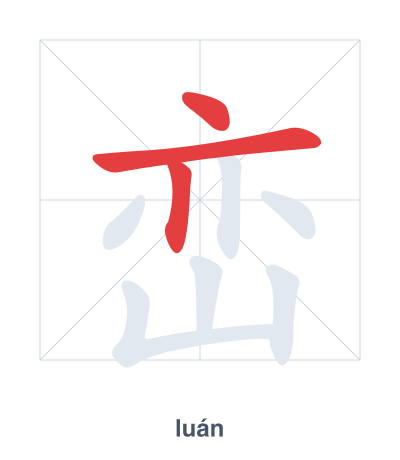
Open Hanzi Writer to see the animated stroke order and practice writing 峦 with real-time feedback.
The character 峦 (luán) is written with 9 strokes. Follow the standard Chinese stroke order: top to bottom, left to right, outside before inside. The radical 山 is one of its key components.
Practice the correct stroke order with the Hanzi Writer app to see animated stroke-by-stroke guidance with real-time feedback.
峦 means mountain range; peak.
峦 is a compound character with the radical 山 (mountain) and a simplified phonetic component 亦 (originally from 䜌). The combination indicates a mountainous area with connected peaks, forming a range.
💡 Memory Tip: Picture a mountain (山) wearing a belt that says 'also' (亦), reminding you that this peak is also part of a whole mountain range.
远处的山峦很美。
yuǎn chù de shān luán hěn měi
The distant mountains are beautiful.
峰峦起伏不断。
fēng luán qǐ fú bù duàn
The mountain peaks rise and fall continuously.
这里重峦叠嶂。
zhè lǐ chóng luán dié zhàng
This place is filled with overlapping peaks and ridges.
Open Hanzi Writer to see the animated stroke order and practice writing 峦 with real-time feedback.
✨ Animated stroke order · Handwriting recognition · HSK-graded practice · Free to use
峦 is a top-bottom character. The top part is 山, which means mountain and gives the meaning of peak or range. The bottom part is 亦, which originally contributed to the sound (though the pronunciation shifted) and adds visual structure.