镂 (lòu) means "To engrave; to carve" in Chinese. It has 14 strokes with the radical 钅.
Rated 4.2/5 in difficulty (advanced).
Appears in 3+ common words including 镂空 (lòu kōng), 雕镂 (diāo lòu), 镂刻 (lòu kè).
Due to its 14 strokes, Hanzi Writer's error detection shows 镂 requires focused practice — most learners need 10+ attempts for consistent accuracy.
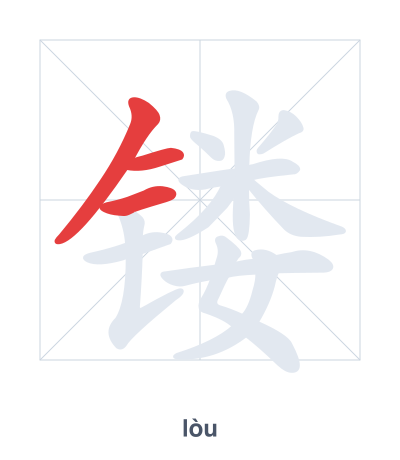
Open Hanzi Writer to see the animated stroke order and practice writing 镂 with real-time feedback.
The character 镂 (lòu) is written with 14 strokes. Follow the standard Chinese stroke order: top to bottom, left to right, outside before inside. The radical 钅 is one of its key components.
Practice the correct stroke order with the Hanzi Writer app to see animated stroke-by-stroke guidance with real-time feedback.
镂 means To engrave; to carve.
镂 is a phono-semantic compound character. The radical 钅 (metal) indicates the action involves a metal tool like a chisel or engraving knife. The right component 娄 (lóu) provides the pronunciation and originally depicted a woman carrying a basket of rice, metaphorically suggesting the patient, repetitive motion of carving into a surface.
💡 Memory Tip: Picture a metal engraving tool (钅) slowly carving a delicate pattern of a woman (女) holding a bowl of rice (米) onto a bronze plaque.
这张纸上镂空了一个花。
zhè zhāng zhǐ shàng lòu kōng le yí gè huā
A flower has been cut out of this paper.
这里的木头雕镂很精美。
zhè lǐ de mù tou diāo lòu hěn jīng měi
The wood carvings here are exquisite.
名字镂刻在石头上面。
míng zì lòu kè zài shí tou shàng miàn
The name is carved on the stone.
Open Hanzi Writer to see the animated stroke order and practice writing 镂 with real-time feedback.
✨ Animated stroke order · Handwriting recognition · HSK-graded practice · Free to use
The left side is 钅, the metal radical, which shows that carving often involves metal tools. The right side 娄 gives the pronunciation hint "lóu." Together, the character means "to engrave" or "carve," typically on hard materials like metal or stone.