屚 (lòu) means "to leak; leakage" in Chinese. It has 11 strokes with the radical 尸.
Rated 4.2/5 in difficulty (advanced).
Appears in 3+ common words including 屋屚 (wū lòu), 屚水 (lòu shuǐ), 屚雨 (lòu yǔ).
Due to its 11 strokes, Hanzi Writer's error detection shows 屚 requires focused practice — most learners need 10+ attempts for consistent accuracy.
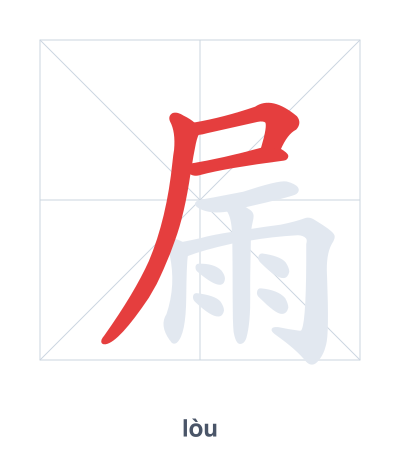
Open Hanzi Writer to see the animated stroke order and practice writing 屚 with real-time feedback.
The character 屚 (lòu) is written with 11 strokes. Follow the standard Chinese stroke order: top to bottom, left to right, outside before inside. The radical 尸 is one of its key components.
Practice the correct stroke order with the Hanzi Writer app to see animated stroke-by-stroke guidance with real-time feedback.
屚 means to leak; leakage.
屚 combines the radical 尸 (here representing a house or roof) with 雨 (rain) to depict rain entering a building, symbolizing a leak. This visual composition directly captures the idea of leakage through a roof.
💡 Memory Tip: Picture a house (尸) with a leaky roof where rain (雨) drips in through a crack.
屋屚偏逢连夜雨。
wū lòu piān féng lián yè yǔ
Misfortunes never come singly.
那个地方在屚水。
nà ge dì fāng zài lòu shuǐ
That place is leaking water.
老房子会屚雨。
lǎo fáng zi huì lòu yǔ
The old house leaks when it rains.
Open Hanzi Writer to see the animated stroke order and practice writing 屚 with real-time feedback.
✨ Animated stroke order · Handwriting recognition · HSK-graded practice · Free to use
屚 is composed of 尸 on top and 雨 below. The radical 尸 originally represents a person or a building, while 雨 means rain. Together they suggest rain coming through a roof, which creates the meaning of leakage.