绺 (liǔ) means "lock; tuft (of hair)" in Chinese. It has 11 strokes with the radical 纟.
Rated 4.2/5 in difficulty (advanced).
Appears in 3+ common words including 一绺 (yī liǔ), 几绺 (jǐ liǔ), 丝绺 (sī liǔ).
Due to its 11 strokes, Hanzi Writer's error detection shows 绺 requires focused practice — most learners need 10+ attempts for consistent accuracy.
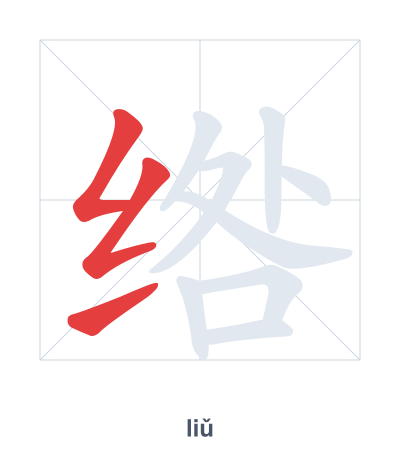
Open Hanzi Writer to see the animated stroke order and practice writing 绺 with real-time feedback.
The character 绺 (liǔ) is written with 11 strokes. Follow the standard Chinese stroke order: top to bottom, left to right, outside before inside. The radical 纟 is one of its key components.
Practice the correct stroke order with the Hanzi Writer app to see animated stroke-by-stroke guidance with real-time feedback.
绺 means lock; tuft (of hair).
绺 combines the silk radical 纟 (thread) with 咎 (fault/tangle), originally describing tangled or knotted silk threads. This meaning extended to a lock or tuft of hair, as hair can similarly become tangled or grouped together.
💡 Memory Tip: A tangled silk thread (纟) with a fault (咎) becomes a messy lock of hair hanging down.
她额前有一绺头发。
tā é qián yǒu yī liǔ tóu fà
She has a lock of hair on her forehead.
他剪下了几绺头发。
tā jiǎn xià le jǐ liǔ tóu fà
He cut off a few locks of hair.
这绺丝线很细。
zhè liǔ sī xiàn hěn xì
This strand of silk thread is very thin.
Open Hanzi Writer to see the animated stroke order and practice writing 绺 with real-time feedback.
✨ Animated stroke order · Handwriting recognition · HSK-graded practice · Free to use
The left side is 纟 (silk thread radical), which connects the character to thread-like things. The right side is 畄 (liǔ), which gives the pronunciation and originally meant "to stay" or "a twist." Together, they suggest a twisted or bundled group of silk threads, which extends to a lock or tuft of hair.