霝 (líng) means "Raindrops; falling rain (archaic)" in Chinese. It has 17 strokes with the radical 雨.
Rated 4.2/5 in difficulty (advanced).
Appears in 3+ common words including 霝雨 (líng yǔ), 霝霝 (líng líng), 霝衣 (líng yī).
Due to its 17 strokes, Hanzi Writer's error detection shows 霝 requires focused practice — most learners need 10+ attempts for consistent accuracy.
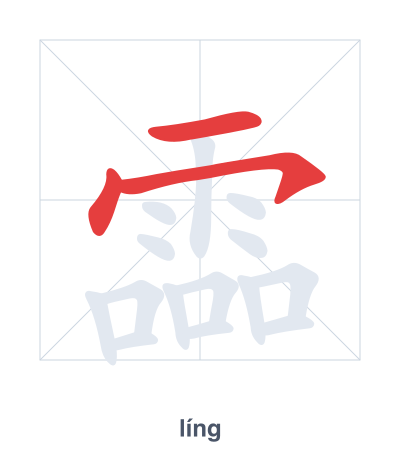
Open Hanzi Writer to see the animated stroke order and practice writing 霝 with real-time feedback.
The character 霝 (líng) is written with 17 strokes. Follow the standard Chinese stroke order: top to bottom, left to right, outside before inside. The radical 雨 is one of its key components.
Practice the correct stroke order with the Hanzi Writer app to see animated stroke-by-stroke guidance with real-time feedback.
霝 means Raindrops; falling rain (archaic).
The character 霝 originally depicted rain falling from clouds, with three dots representing individual raindrops. Over time, the dots became three 'mouth' shapes (品) beneath the rain radical (雨), symbolizing the pattering sound or sight of raindrops.
💡 Memory Tip: Picture rain (雨) falling onto three open mouths (口口口) that are singing 'ling' as they catch the raindrops.
霝雨从天上落下。
líng yǔ cóng tiān shàng là xià
Rain falls from the sky.
泉水声霝霝。
quán shuǐ shēng líng líng
The sound of the spring water is like falling rain.
他穿着一件霝衣。
tā chuān zhe yī jiàn líng yī
He is wearing a ceremonial rain robe.
Open Hanzi Writer to see the animated stroke order and practice writing 霝 with real-time feedback.
✨ Animated stroke order · Handwriting recognition · HSK-graded practice · Free to use
The character 霝 has the radical 雨 (rain) on top, which directly links to its meaning of rain. The lower part consists of three 口 (mouth) shapes arranged vertically, which in ancient texts represented the sound or pattern of falling raindrops. Together, the components create a visual and symbolic image of rain falling with a pattering sound.