蔺 (lìn) means "rush (a type of grass)" in Chinese. It has 14 strokes with the radical 艹.
Rated 4.2/5 in difficulty (advanced).
Appears in 3+ common words including 蔺草 (lìn cǎo), 蔺席 (lìn xí), 姓蔺 (xìng lìn).
Due to its 14 strokes, Hanzi Writer's error detection shows 蔺 requires focused practice — most learners need 10+ attempts for consistent accuracy.
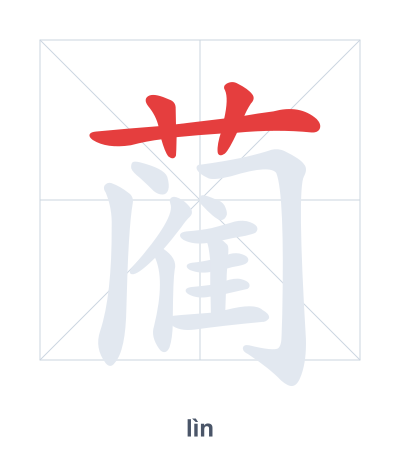
Open Hanzi Writer to see the animated stroke order and practice writing 蔺 with real-time feedback.
The character 蔺 (lìn) is written with 14 strokes. Follow the standard Chinese stroke order: top to bottom, left to right, outside before inside. The radical 艹 is one of its key components.
Practice the correct stroke order with the Hanzi Writer app to see animated stroke-by-stroke guidance with real-time feedback.
蔺 means rush (a type of grass).
蔺 combines the grass radical 艹 with the phonetic component 閵 (lìn), which depicts a bird (隹) inside a gate (門). The grass radical indicates it is a type of plant, specifically a rush used for weaving mats.
💡 Memory Tip: Picture a lush rush plant (艹) growing so thickly around a gate (門) that a bird (隹) gets trapped inside, struggling to escape.
蔺草可以织席子。
lìn cǎo kě yǐ zhī xí zi
Rush grass can be used to weave mats.
夏天睡蔺席很凉快。
xià tiān shuì lìn xí hěn liáng kuài
Sleeping on a rush mat in summer is very cool.
我的老师姓蔺。
wǒ de lǎo shī xìng lìn
My teacher's surname is Lin.
Open Hanzi Writer to see the animated stroke order and practice writing 蔺 with real-time feedback.
✨ Animated stroke order · Handwriting recognition · HSK-graded practice · Free to use
蔺 is a top-bottom structure with the radical 艹 (grass) on top and 閵 (lìn) below. The 艹 indicates the character relates to plants or grasses, while the lower part gives the sound 'lìn' and originally referred to a type of rush grass used for weaving mats.