埒 (liè) means "Embankment; boundary; equal." in Chinese. It has 10 strokes with the radical 土.
Rated 4.2/5 in difficulty (advanced).
Appears in 3+ common words including 埒才 (liè cái), 埒名 (liè míng), 埒等 (liè děng).
Due to its 10 strokes, Hanzi Writer's error detection shows 埒 requires focused practice — most learners need 10+ attempts for consistent accuracy.
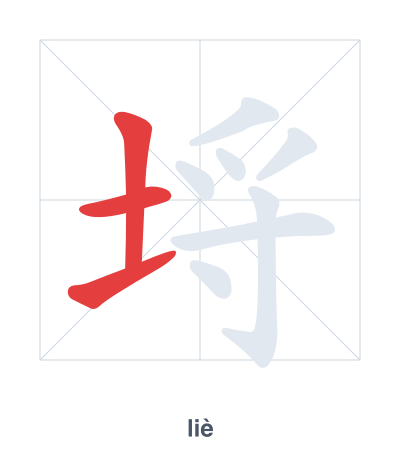
Open Hanzi Writer to see the animated stroke order and practice writing 埒 with real-time feedback.
The character 埒 (liè) is written with 10 strokes. Follow the standard Chinese stroke order: top to bottom, left to right, outside before inside. The radical 土 is one of its key components.
Practice the correct stroke order with the Hanzi Writer app to see animated stroke-by-stroke guidance with real-time feedback.
埒 means Embankment; boundary; equal..
埒 combines the radical 土 (earth, mound) with 寽, a phonetic component that originally depicted a hand grasping or smoothing. Together, they suggest a low earthen wall or embankment that creates a boundary, and by extension, something that is level or equal to another.
💡 Memory Tip: Picture two equal mounds of earth (土) with a hand (寽) smoothing them into a flat boundary line between fields.
他的才华与你埒才。
tā de cái huá yǔ nǐ liè cái
His talent is equal to yours.
两人在埒名。
liǎng rén zài liè míng
The two are competing for fame.
他们的水平埒等。
tā men de shuǐ píng liè děng
Their levels are equal.
Open Hanzi Writer to see the animated stroke order and practice writing 埒 with real-time feedback.
✨ Animated stroke order · Handwriting recognition · HSK-graded practice · Free to use
埒 consists of the radical 土 (earth) on the left and 寽 (lǜ, a phonetic component) on the right. The earth radical connects to the character's meaning of an embankment or boundary, while 寽 provides the pronunciation.