砺 (lì) means "whetstone / to grind" in Chinese. It has 10 strokes with the radical 石.
Rated 4.2/5 in difficulty (advanced).
Appears in 3+ common words including 磨砺 (mó lì), 砥砺 (dǐ lì), 砺石 (lì shí).
Due to its 10 strokes, Hanzi Writer's error detection shows 砺 requires focused practice — most learners need 10+ attempts for consistent accuracy.
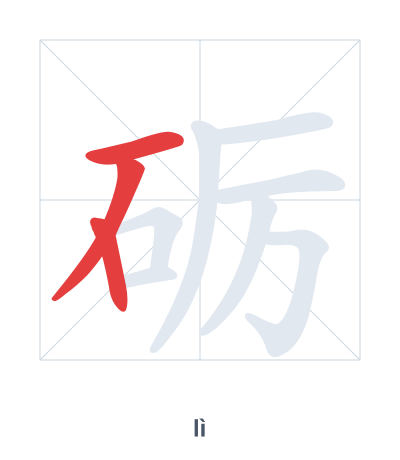
Open Hanzi Writer to see the animated stroke order and practice writing 砺 with real-time feedback.
The character 砺 (lì) is written with 10 strokes. Follow the standard Chinese stroke order: top to bottom, left to right, outside before inside. The radical 石 is one of its key components.
Practice the correct stroke order with the Hanzi Writer app to see animated stroke-by-stroke guidance with real-time feedback.
砺 means whetstone / to grind.
砺 is a phono-semantic compound with 石 (stone) indicating its connection to a whetstone, and 厉 (lì) providing the sound and hinting at the action of sharpening or grinding, as 厉 originally meant 'sharp' or 'severe.'
💡 Memory Tip: Picture a scorpion (万) on a cliff (厂) furiously scraping a stone (石) to sharpen a blade.
困难可以磨砺意志。
kùn nán kě yǐ mó lì yì zhì
Difficulties can temper one's will.
我们要砥砺前行。
wǒ men yào dǐ lì qián xíng
We must forge ahead.
这是一块砺石。
zhè shì yī kuài lì shí
This is a whetstone.
Open Hanzi Writer to see the animated stroke order and practice writing 砺 with real-time feedback.
✨ Animated stroke order · Handwriting recognition · HSK-graded practice · Free to use
砺 is composed of the radical 石 (stone) on the left and the phonetic component 厉 (lì) on the right. The stone radical relates to the meaning "whetstone" or "grinding stone," while 厉 provides pronunciation. Together, they form a character about sharpening or grinding with a stone.