溧 (lì) means "Li (used in place names)" in Chinese. It has 13 strokes with the radical 氵.
Rated 4.2/5 in difficulty (advanced).
Appears in 3+ common words including 溧水 (lì shuǐ), 溧阳 (lì yáng), 溧河 (lì hé).
Due to its 13 strokes, Hanzi Writer's error detection shows 溧 requires focused practice — most learners need 10+ attempts for consistent accuracy.
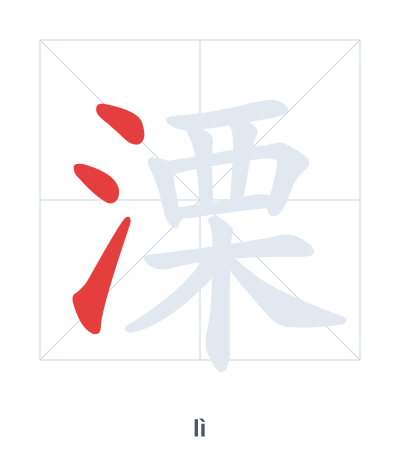
Open Hanzi Writer to see the animated stroke order and practice writing 溧 with real-time feedback.
The character 溧 (lì) is written with 13 strokes. Follow the standard Chinese stroke order: top to bottom, left to right, outside before inside. The radical 氵 is one of its key components.
Practice the correct stroke order with the Hanzi Writer app to see animated stroke-by-stroke guidance with real-time feedback.
溧 means Li (used in place names).
溧 is a phono-semantic compound: the left radical 氵 (water) indicates a river or body of water, and the right component 栗 (lì, meaning 'chestnut') provides the pronunciation. It appears in ancient place names like 溧水 (Li River) in Jiangsu, where chestnut trees may have grown along the banks.
💡 Memory Tip: Picture a chestnut (栗) floating on water (氵) to mark the location of the Li River.
我去过溧水。
wǒ qù guò lì shuǐ
I have been to Lishui.
溧阳是个好地方。
lì yáng shì gè hǎo dì fāng
Liyang is a good place.
溧河的水很清。
lì hé de shuǐ hěn qīng
The water of the Li River is very clear.
Open Hanzi Writer to see the animated stroke order and practice writing 溧 with real-time feedback.
✨ Animated stroke order · Handwriting recognition · HSK-graded practice · Free to use
The character 溧 is made of two parts: the radical 氵 on the left, which means "water," and the component 栗 (lì, chestnut) on the right. The water radical suggests that 溧 is often used in place names related to rivers or lakes, while 栗 gives the character its pronunciation but not its meaning.