悧 (lì) means "clever" in Chinese. It has 10 strokes with the radical 忄.
Rated 4.2/5 in difficulty (advanced).
Appears in 3+ common words including 伶悧 (líng lì), 悧巧 (lì qiǎo), 聪明伶悧 (cōng míng líng lì).
Due to its 10 strokes, Hanzi Writer's error detection shows 悧 requires focused practice — most learners need 10+ attempts for consistent accuracy.
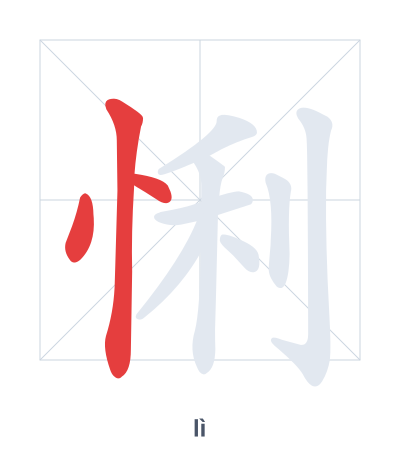
Open Hanzi Writer to see the animated stroke order and practice writing 悧 with real-time feedback.
The character 悧 (lì) is written with 10 strokes. Follow the standard Chinese stroke order: top to bottom, left to right, outside before inside. The radical 忄 is one of its key components.
Practice the correct stroke order with the Hanzi Writer app to see animated stroke-by-stroke guidance with real-time feedback.
悧 means clever.
悧 combines the heart radical 忄 (mind or emotion) with 利 (sharp, benefit), implying a mind that is sharp and quick to grasp advantage — hence 'clever'.
💡 Memory Tip: Imagine a sharp knife (利) slicing through confusion in your heart (忄) to reveal a clever solution.
这孩子真伶悧。
zhè hái zi zhēn líng lì
This child is really clever.
她做事很悧巧。
tā zuò shì hěn lì qiǎo
She is very clever and efficient in her work.
他长得聪明伶悧。
tā zhǎng dé cōng míng líng lì
He is clever and quick-witted.
Open Hanzi Writer to see the animated stroke order and practice writing 悧 with real-time feedback.
✨ Animated stroke order · Handwriting recognition · HSK-graded practice · Free to use
悧 has two parts: the radical 忄 (heart) on the left, and 利 (sharp, benefit) on the right. The heart radical connects to emotions or intelligence, while 利 adds the idea of being sharp or quick, together suggesting a "sharp mind" or cleverness.