伶 (líng) means "clever; actor" in Chinese. It has 7 strokes with the radical 亻.
Rated 3.2/5 in difficulty (challenging).
Appears in 3+ common words including 伶俐 (líng lì), 伶人 (líng rén), 孤苦伶仃 (gū kǔ líng dīng).
Due to its 7 strokes, Hanzi Writer's error detection shows 伶 requires focused practice — most learners need 10+ attempts for consistent accuracy.
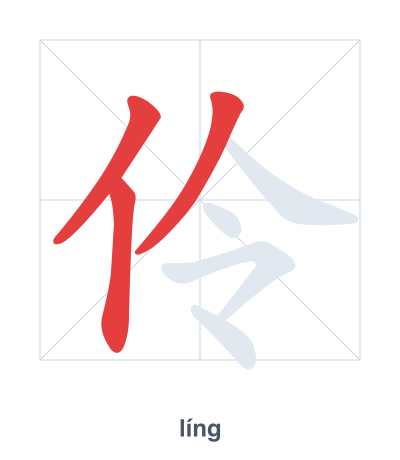
Open Hanzi Writer to see the animated stroke order and practice writing 伶 with real-time feedback.
The character 伶 (líng) is written with 7 strokes. Follow the standard Chinese stroke order: top to bottom, left to right, outside before inside. The radical 亻 is one of its key components.
Practice the correct stroke order with the Hanzi Writer app to see animated stroke-by-stroke guidance with real-time feedback.
伶 means clever; actor.
The character 伶 combines the radical 亻 (person) with 令 (lìng, 'command' or 'order'), suggesting a person who follows instructions skillfully—like an actor performing on cue. In ancient China, 伶 referred to court musicians or performers, valued for their cleverness and artistry.
💡 Memory Tip: Imagine a clever actor (亻) receiving a command (令) and instantly performing a hilarious improv scene.
这个孩子很伶俐。
zhè ge hái zi hěn líng lì
This child is very clever and sharp.
他以前是个伶人。
tā yǐ qián shì gè líng rén
He used to be an actor.
他一个人孤苦伶仃。
tā yí gè rén gū kǔ líng dīng
He is all alone and helpless.
Open Hanzi Writer to see the animated stroke order and practice writing 伶 with real-time feedback.
✨ Animated stroke order · Handwriting recognition · HSK-graded practice · Free to use
伶 is made of the radical 亻 (person) on the left and a phonetic component 令 (líng) on the right. The radical indicates that the character relates to people, while 令 gives the pronunciation and also suggests order or performance, connecting to the meanings of "clever" and "actor".