缡 (lí) means "bridal veil; sash" in Chinese. It has 13 strokes with the radical 纟.
Rated 4.2/5 in difficulty (advanced).
Appears in 3+ common words including 结缡 (jié lí), 缡袂 (lí mèi), 缡带 (lí dài).
Due to its 13 strokes, Hanzi Writer's error detection shows 缡 requires focused practice — most learners need 10+ attempts for consistent accuracy.
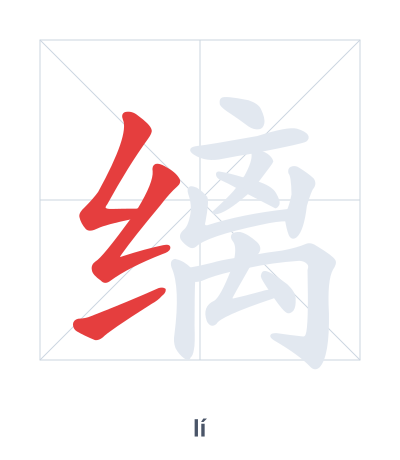
Open Hanzi Writer to see the animated stroke order and practice writing 缡 with real-time feedback.
The character 缡 (lí) is written with 13 strokes. Follow the standard Chinese stroke order: top to bottom, left to right, outside before inside. The radical 纟 is one of its key components.
Practice the correct stroke order with the Hanzi Writer app to see animated stroke-by-stroke guidance with real-time feedback.
缡 means bridal veil; sash.
缡 is a phonetic-semantic compound: the radical 纟 (silk thread) indicates the material, while 离 (lí, 'to leave') provides the sound and hints at the veil's role in a bride's departure from her family.
💡 Memory Tip: Picture a silk veil (纟) that a bride wears as she says goodbye (离) to her family—left side silk, right side 'leave'.
他们今天结缡。
tā men jīn tiān jié lí
They are getting married today.
缡袂在风中飘动。
lí mèi zài fēng zhōng piāo dòng
The sleeves are fluttering in the wind.
这条缡带很长。
zhè tiáo lí dài hěn zhǎng
This sash is very long.
Open Hanzi Writer to see the animated stroke order and practice writing 缡 with real-time feedback.
✨ Animated stroke order · Handwriting recognition · HSK-graded practice · Free to use
The left side is the radical 纟, meaning silk or thread, which connects to the character's meaning of cloth items like a sash or veil. The right side is 离 (lí), which provides the pronunciation and originally depicted a net or bird trap, but here it acts mainly as a phonetic component.