Hanzi Writer

How to Write 榄 (lǎn) — Meaning “olive”

lǎn 13 strokes Radical: 木

榄 (lǎn) means "olive" in Chinese. It has 13 strokes with the radical 木.

Rated 4.2/5 in difficulty (advanced).

Appears in 3+ common words including 橄榄 (gǎn lǎn), 橄榄油 (gǎn lǎn yóu), 橄榄球 (gǎn lǎn qiú).

Due to its 13 strokes, Hanzi Writer's error detection shows 榄 requires focused practice — most learners need 10+ attempts for consistent accuracy.
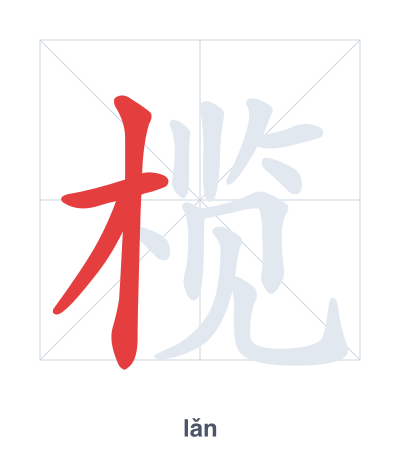
Stroke order practice for 榄 - lǎn

Practice Writing 榄 (lǎn)

Open Hanzi Writer to see the animated stroke order and practice writing 榄 with real-time feedback.

The character (lǎn) is written with 13 strokes. Follow the standard Chinese stroke order: top to bottom, left to right, outside before inside. The radical is one of its key components.

Practice the correct stroke order with the Hanzi Writer app to see animated stroke-by-stroke guidance with real-time feedback.

means olive.

Character
Pinyinlǎn (lan)
Meaningolive
Strokes13
Radical
Difficulty4.2/5

榄 is a phono-semantic compound combining the radical 木 (tree) with 览 (lǎn, meaning 'to view' or 'to see'), which provides the pronunciation. The olive is a fruit that grows on trees, so 木 signifies the tree category, while 览 acts purely as a phonetic component with no direct semantic link to olives.

💡 Memory Tip: Picture someone using binoculars (览) to look at an olive tree (木) to check if the olives are ripe.

gǎn lǎn
olive
gǎn lǎn yóu
olive oil
gǎn lǎn qiú
American football / Rugby

我喜欢吃橄榄。

wǒ xǐ huān chī gǎn lǎn

I like eating olives.

橄榄油对身体很好。

gǎn lǎn yóu duì shēn tǐ hěn hǎo

Olive oil is very good for your health.

他喜欢打橄榄球。

tā xǐ huān dǎ gǎn lǎn qiú

He likes playing American football.

Character Pinyin Strokes Radical
(current) lǎn 13
suō 11
po 11
11
Stroke order practice for 榄 - lǎn

Practice Writing 榄 (lǎn)

Open Hanzi Writer to see the animated stroke order and practice writing 榄 with real-time feedback.

✨ Animated stroke order · Handwriting recognition · HSK-graded practice · Free to use

Frequently Asked Questions about 榄

榄 is made of the radical 木 (tree/wood) on the left, and the phonetic component 览 on the right. The radical 木 indicates that the character relates to a tree or wood, and 榄 specifically refers to the olive tree or its fruit.

Characters with Radical 木

Other 13-Stroke Characters