傀 (kuǐ) means "puppet; grand; strange" in Chinese. It has 11 strokes with the radical 亻.
Rated 3.9/5 in difficulty (challenging).
Appears in 3+ common words including 傀儡 (kuǐ lěi), 傀儡戏 (kuǐ lěi xì), 傀儡政权 (kuǐ lěi zhèng quán).
Due to its 11 strokes, Hanzi Writer's error detection shows 傀 requires focused practice — most learners need 10+ attempts for consistent accuracy.
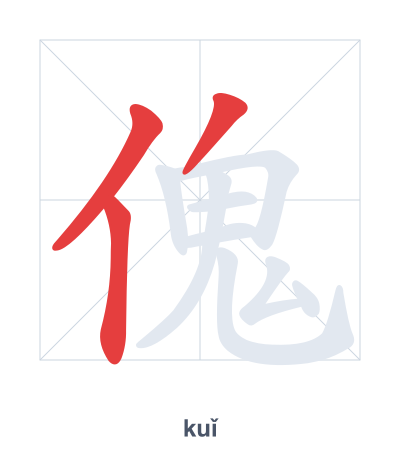
Open Hanzi Writer to see the animated stroke order and practice writing 傀 with real-time feedback.
The character 傀 (kuǐ) is written with 11 strokes. Follow the standard Chinese stroke order: top to bottom, left to right, outside before inside. The radical 亻 is one of its key components.
Practice the correct stroke order with the Hanzi Writer app to see animated stroke-by-stroke guidance with real-time feedback.
傀 means puppet; grand; strange.
The character 傀 combines the radical 亻 (person) with 鬼 (ghost). A person who acts like a ghost seems strange or eerie, and this also evokes the jerky, lifelike movements of a puppet—as if animated by a ghostly force.
💡 Memory Tip: Picture a person (亻) wearing a ghost (鬼) costume, dangling from strings like a puppet on stage.
他只是个傀儡。
tā zhǐ shì gè kuǐ lěi
He is just a puppet.
我爱看傀儡戏。
wǒ ài kàn kuǐ lěi xì
I love watching puppet shows.
这是一个傀儡政权。
zhè shì yí gè kuǐ lěi zhèng quán
This is a puppet regime.
Open Hanzi Writer to see the animated stroke order and practice writing 傀 with real-time feedback.
✨ Animated stroke order · Handwriting recognition · HSK-graded practice · Free to use
The character 傀 consists of the radical 亻 (person) on the left and 鬼 (ghost) on the right. This combination suggests a 'person' that is like a 'ghost' – something strange or controlled by others, which connects to the meanings of 'puppet' and 'strange'.