眍 (kōu) means "sunken (eyes)" in Chinese. It has 9 strokes with the radical 目.
Rated 4/5 in difficulty (challenging).
Appears in 3+ common words including 眍搂 (kōu lǒu), 眍眼 (kōu yǎn), 眍进去 (kōu jìn qù).
Due to its 9 strokes, Hanzi Writer's error detection shows 眍 requires focused practice — most learners need 10+ attempts for consistent accuracy.
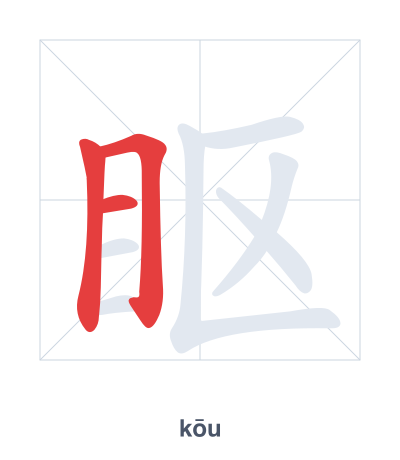
Open Hanzi Writer to see the animated stroke order and practice writing 眍 with real-time feedback.
The character 眍 (kōu) is written with 9 strokes. Follow the standard Chinese stroke order: top to bottom, left to right, outside before inside. The radical 目 is one of its key components.
Practice the correct stroke order with the Hanzi Writer app to see animated stroke-by-stroke guidance with real-time feedback.
眍 means sunken (eyes).
This compound character combines the radical 目 (eye) with 区 (area/hollow), suggesting eyes that appear sunken into hollow sockets. The component 区 contributes both phonetic value (kōu) and a semantic hint of a concave shape.
💡 Memory Tip: Imagine an eye (目) sinking into a hollow (区) like a sunken eyeball retreating into its socket.
他的眼睛眍搂着。
tā de yǎn jīng kōu lǒu zhe
His eyes are sunken.
他有一双眍眼。
tā yǒu yī shuāng kōu yǎn
He has a pair of sunken eyes.
他的眼眶眍进去了。
tā de yǎn kuàng kōu jìn qù le
His eye sockets are sunken.
Open Hanzi Writer to see the animated stroke order and practice writing 眍 with real-time feedback.
✨ Animated stroke order · Handwriting recognition · HSK-graded practice · Free to use
眍 is made of the radical 目 (eye) on the left and the component 区 (qū) on the right. The 目 indicates the meaning is about eyes, while 区 provides the pronunciation kōu and also suggests a hollow or sunken shape, like a depressed area. Together they describe eyes that are sunken inwards.