铿 (kēng) means "Clang / Resonant sound" in Chinese. It has 12 strokes with the radical 钅.
Rated 4.2/5 in difficulty (advanced).
Appears in 3+ common words including 铿锵有力 (kēng qiāng yǒu lì), 铿锵 (kēng qiāng), 铿然 (kēng rán).
Due to its 12 strokes, Hanzi Writer's error detection shows 铿 requires focused practice — most learners need 10+ attempts for consistent accuracy.
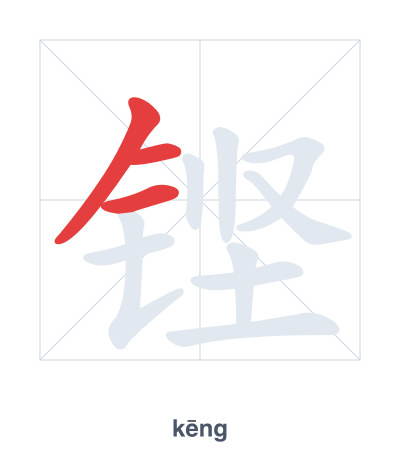
Open Hanzi Writer to see the animated stroke order and practice writing 铿 with real-time feedback.
The character 铿 (kēng) is written with 12 strokes. Follow the standard Chinese stroke order: top to bottom, left to right, outside before inside. The radical 钅 is one of its key components.
Practice the correct stroke order with the Hanzi Writer app to see animated stroke-by-stroke guidance with real-time feedback.
铿 means Clang / Resonant sound.
铿 is a phono-semantic compound: the radical 钅 (metal) signifies the material that produces the sound, while the phonetic component 坚 (jiān, meaning 'hard/firm') hints at striking a hard metal object to produce a resonant clang.
💡 Memory Tip: Imagine a metal (钅) bell so hard (坚) that when struck, it rings out a loud 'KENG!' sound.
他的发言铿锵有力。
tā de fā yán kēng qiāng yǒu lì
His speech was powerful and resonant.
音乐节奏很铿锵。
yīn yuè jié zòu hěn kēng qiāng
The rhythm of the music is sonorous.
传来一声铿然巨响。
chuán lái yī shēng kēng rán jù xiǎng
A loud, metallic crash rang out.
Open Hanzi Writer to see the animated stroke order and practice writing 铿 with real-time feedback.
✨ Animated stroke order · Handwriting recognition · HSK-graded practice · Free to use
铿 is composed of the metal radical 钅 on the left and the character 坚 (jiān, meaning firm or hard) on the right. The metal radical suggests a metallic object, while 坚 adds the idea of hardness — together they describe the sharp, resonant clang of metal striking something hard.