伉 (kàng) means "Upright; a match or equal" in Chinese. It has 6 strokes with the radical 亻.
Rated 2.9/5 in difficulty (moderate).
Appears in 3+ common words including 伉俪 (kàng lì), 伉健 (kàng jiàn), 伉直 (kàng zhí).
Hanzi Writer's stroke validation shows learners typically need 5-8 attempts to write 伉 with correct proportion and order.
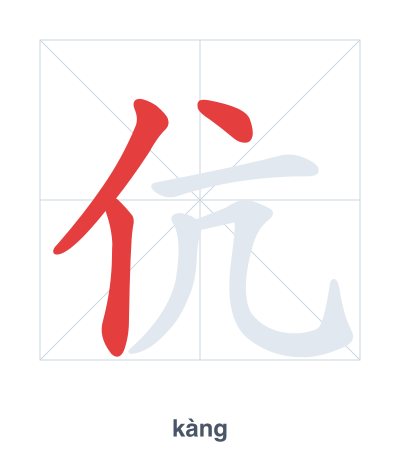
Open Hanzi Writer to see the animated stroke order and practice writing 伉 with real-time feedback.
The character 伉 (kàng) is written with 6 strokes. Follow the standard Chinese stroke order: top to bottom, left to right, outside before inside. The radical 亻 is one of its key components.
Practice the correct stroke order with the Hanzi Writer app to see animated stroke-by-stroke guidance with real-time feedback.
伉 means Upright; a match or equal.
伉 combines the radical 亻 (person) with 亢 (high/lofty), indicating a person of high moral character—upright and honorable. In ancient usage, it also meant 'a match' or 'equal,' as in 伉俪 (a married couple), because both partners are of equal standing.
💡 Memory Tip: Picture a person (亻) standing as tall and straight as a flagpole (亢), perfectly matched to their partner in height and virtue.
祝这对伉俪幸福。
zhù zhè duì kàng lì xìng fú
Wishing this couple happiness.
他的身体很伉健。
tā de shēn tǐ hěn kàng jiàn
His body is very robust and healthy.
他为人很伉直。
tā wéi rén hěn kàng zhí
He is very upright and outspoken.
Open Hanzi Writer to see the animated stroke order and practice writing 伉 with real-time feedback.
✨ Animated stroke order · Handwriting recognition · HSK-graded practice · Free to use
The character 伉 combines the radical 亻 (person) on the left with 亢 (kàng) on the right. 亢 means "high" or "strong," so a person standing tall and strong suggests "upright" or "a match." This structure shows that 伉 describes someone of strong character or an equal counterpart.