镢 (jué) means "pickaxe" in Chinese. It has 17 strokes with the radical 钅.
Rated 4.2/5 in difficulty (advanced).
Appears in 3+ common words including 镢头 (jué tóu), 铁镢 (tiě jué), 挥镢 (huī jué).
Due to its 17 strokes, Hanzi Writer's error detection shows 镢 requires focused practice — most learners need 10+ attempts for consistent accuracy.
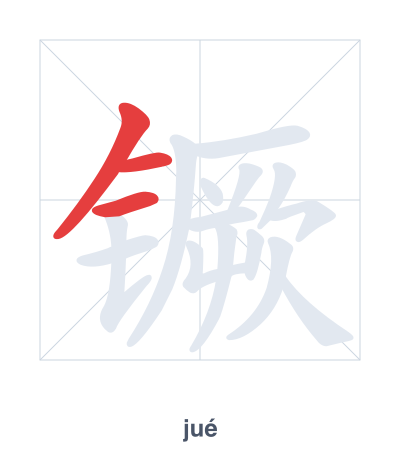
Open Hanzi Writer to see the animated stroke order and practice writing 镢 with real-time feedback.
The character 镢 (jué) is written with 17 strokes. Follow the standard Chinese stroke order: top to bottom, left to right, outside before inside. The radical 钅 is one of its key components.
Practice the correct stroke order with the Hanzi Writer app to see animated stroke-by-stroke guidance with real-time feedback.
镢 means pickaxe.
镢 is a phono-semantic compound where 钅 (gold/metal) indicates it's a metal tool, and 厥 provides the pronunciation (jué) while also suggesting the digging motion—as 厥 appears in words like 挖掘 (wā jué, 'to dig'). The character visually combines a metal implement with a component hinting at the action of prying or excavating, forming the meaning 'pickaxe'.
💡 Memory Tip: Imagine a miner using a metal pickaxe (钅) to pry open a stubborn rock, and the right side 厥 looks like a person bent over with arms swinging down to strike.
他拿着镢头去挖地。
tā ná zhe jué tóu qù wā dì
He took a pickaxe to dig the ground.
铁镢非常沉重。
tiě jué fēi cháng chén zhòng
The iron mattock is very heavy.
他在用力挥镢。
tā zài yòng lì huī jué
He is swinging the pickaxe with force.
Open Hanzi Writer to see the animated stroke order and practice writing 镢 with real-time feedback.
✨ Animated stroke order · Handwriting recognition · HSK-graded practice · Free to use
镢 is composed of the radical 钅 (metal/gold) on the left and the phonetic component 厥 (jué) on the right. The metal radical shows that a pickaxe is a metal tool, while 厥 gives the pronunciation. Together they form the character for a farming or digging tool.