蕨 (jué) means "Fern / Bracken" in Chinese. It has 15 strokes with the radical 艹.
Rated 4.2/5 in difficulty (advanced).
Appears in 3+ common words including 蕨菜 (jué cài), 蕨类 (jué lèi), 山蕨 (shān jué).
Due to its 15 strokes, Hanzi Writer's error detection shows 蕨 requires focused practice — most learners need 10+ attempts for consistent accuracy.
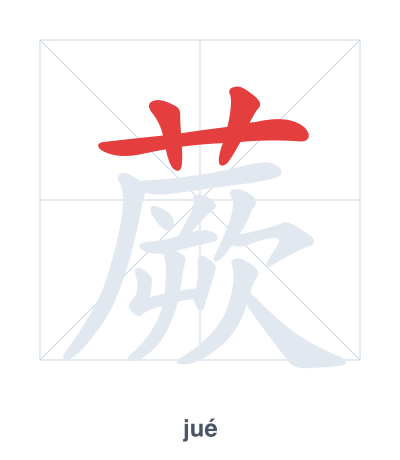
Open Hanzi Writer to see the animated stroke order and practice writing 蕨 with real-time feedback.
The character 蕨 (jué) is written with 15 strokes. Follow the standard Chinese stroke order: top to bottom, left to right, outside before inside. The radical 艹 is one of its key components.
Practice the correct stroke order with the Hanzi Writer app to see animated stroke-by-stroke guidance with real-time feedback.
蕨 means Fern / Bracken.
This is a phono-semantic compound: the radical 艹 (grass) marks it as a plant, while 厥 (jué, meaning 'to collapse' or 'a stake') gives the sound and visually suggests the fern's fronds curling inward like a fallen shape. Ancient forms show a grass radical atop a component resembling a person or object, reinforcing the idea of a plant with coiled young shoots.
💡 Memory Tip: Picture the grass (艹) on top of a man (厥) who is tripping over a fern frond, causing his leg to twist into a curled bracken shape.
我喜欢吃炒蕨菜。
wǒ xǐ huān chī chǎo jué cài
I like eating stir-fried bracken.
蕨类植物喜欢水。
jué lèi zhí wù xǐ huān shuǐ
Ferns like water.
山上有许多山蕨。
shān shàng yǒu xǔ duō shān jué
There are many mountain ferns on the mountain.
Open Hanzi Writer to see the animated stroke order and practice writing 蕨 with real-time feedback.
✨ Animated stroke order · Handwriting recognition · HSK-graded practice · Free to use
The character 蕨 has the radical 艹 (grass) on top, showing it is a type of plant. The bottom part is 厥 (jué), which gives the sound and originally meant "to dig out" — fern shoots are dug from the ground. Together, 蕨 means a plant that grows from the ground, specifically a fern.