菹 (jū) means "pickled vegetables; marshland" in Chinese. It has 11 strokes with the radical 艹.
Rated 4.2/5 in difficulty (advanced).
Appears in 3+ common words including 菹草 (jū cǎo), 腌菹 (yān jū), 菜菹 (cài jū).
Due to its 11 strokes, Hanzi Writer's error detection shows 菹 requires focused practice — most learners need 10+ attempts for consistent accuracy.
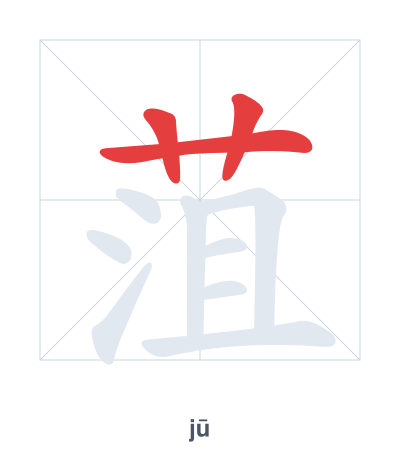
Open Hanzi Writer to see the animated stroke order and practice writing 菹 with real-time feedback.
The character 菹 (jū) is written with 11 strokes. Follow the standard Chinese stroke order: top to bottom, left to right, outside before inside. The radical 艹 is one of its key components.
Practice the correct stroke order with the Hanzi Writer app to see animated stroke-by-stroke guidance with real-time feedback.
菹 means pickled vegetables; marshland.
菹 is a phono-semantic compound: the radical 艹 (grass/plants) indicates vegetables, while 且 (jū) provides the pronunciation. Originally it referred to pickled vegetables, created by immersing plants in brine, and later extended to mean marshland, where waterlogged grasses grow.
💡 Memory Tip: Picture a jar (且) packed with grass (艹) soaking in brine—that's your pickled vegetables (菹).
水里有很多菹草。
shuǐ lǐ yǒu hěn duō jū cǎo
There is a lot of curly-leaf pondweed in the water.
他喜欢吃腌菹。
tā xǐ huān chī yān jū
He likes eating pickles.
桌上有一盘菜菹。
zhuō shàng yǒu yī pán cài jū
There is a plate of pickled vegetables on the table.
Open Hanzi Writer to see the animated stroke order and practice writing 菹 with real-time feedback.
✨ Animated stroke order · Handwriting recognition · HSK-graded practice · Free to use
The character 菹 is composed of the radical 艹 (grass) on top and 且 (which originally meant an altar or a block) underneath. The grass radical connects to plants or vegetables, while the lower part suggests a container or place, together indicating pickled vegetables stored in a container or marshland where plants grow.