襟 (jīn) means "lapel or the front of a garment" in Chinese. It has 18 strokes with the radical 衤.
Rated 4.2/5 in difficulty (advanced).
Appears in 3+ common words including 衣襟 (yī jīn), 胸襟 (xiōng jīn), 对襟 (duì jīn).
Due to its 18 strokes, Hanzi Writer's error detection shows 襟 requires focused practice — most learners need 10+ attempts for consistent accuracy.
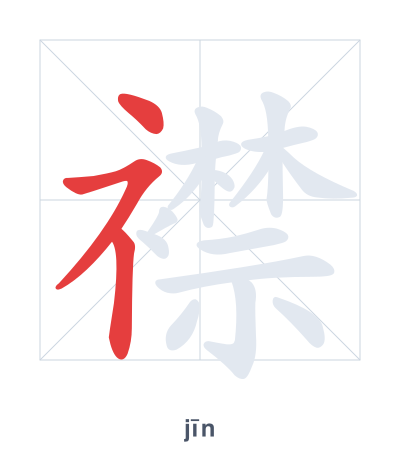
Open Hanzi Writer to see the animated stroke order and practice writing 襟 with real-time feedback.
The character 襟 (jīn) is written with 18 strokes. Follow the standard Chinese stroke order: top to bottom, left to right, outside before inside. The radical 衤 is one of its key components.
Practice the correct stroke order with the Hanzi Writer app to see animated stroke-by-stroke guidance with real-time feedback.
襟 means lapel or the front of a garment.
襟 is a phono-semantic compound. The left radical 衤 (clothes) indicates it relates to garments. The right component 禁 (jìn, meaning 'prohibit') provides the pronunciation, and the character refers to the front part or lapel of a coat or robe, the overlapping section that closes the garment.
💡 Memory Tip: Imagine your jacket's lapel is so sharp that it's forbidden (禁) to touch the cloth (衤) — it's a crime against fashion!
别把墨水弄到衣襟上。
bié bǎ mò shuǐ nòng dào yī jīn shàng
Don't get ink on your clothes.
他的胸襟很开阔。
tā de xiōng jīn hěn kāi kuò
He is very broad-minded.
这是一件对襟上衣。
zhè shì yī jiàn duì jīn shàng yī
This is a front-opening jacket.
Open Hanzi Writer to see the animated stroke order and practice writing 襟 with real-time feedback.
✨ Animated stroke order · Handwriting recognition · HSK-graded practice · Free to use
The left radical 衤 means "clothing," indicating that the character relates to garments. The right side 禁 (jìn) gives the pronunciation and originally meant "forbid," but here it acts as a phonetic component. Together, they form a character that refers to the lapel or front of a garment.