Hanzi Writer

How to Write 铰 (jiǎo) — Meaning “To cut with scissors”

jiǎo 11 strokes Radical: 钅

铰 (jiǎo) means "To cut with scissors" in Chinese. It has 11 strokes with the radical 钅.

Rated 4.2/5 in difficulty (advanced).

Appears in 3+ common words including 铰链 (jiǎo liàn), 铰头发 (jiǎo tóu fà), 铰刀 (jiǎo dāo).

Due to its 11 strokes, Hanzi Writer's error detection shows 铰 requires focused practice — most learners need 10+ attempts for consistent accuracy.
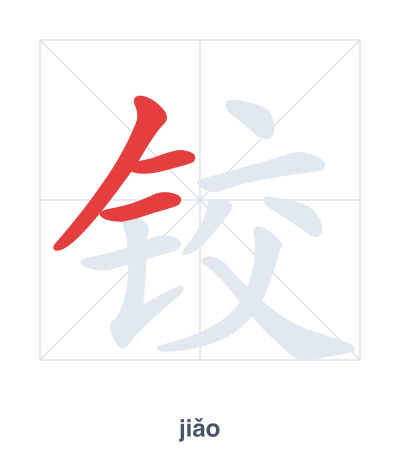
Stroke order practice for 铰 - jiǎo

Practice Writing 铰 (jiǎo)

Open Hanzi Writer to see the animated stroke order and practice writing 铰 with real-time feedback.

The character (jiǎo) is written with 11 strokes. Follow the standard Chinese stroke order: top to bottom, left to right, outside before inside. The radical is one of its key components.

Practice the correct stroke order with the Hanzi Writer app to see animated stroke-by-stroke guidance with real-time feedback.

means To cut with scissors.

Character
Pinyinjiǎo (jiao)
MeaningTo cut with scissors
Strokes11
Radical
Difficulty4.2/5

铰 combines the radical 钅 (metal, representing the material of scissors) with 交 (jiāo, meaning 'to cross' or 'intersect'), which visually depicts the crossing blades of scissors. Together, the character shows a tool made of metal that cuts by crossing its two parts.

💡 Memory Tip: Imagine a pair of scissors with golden blades (钅) that cross each other (交) to snip through paper.

jiǎo liàn
Hinge
jiǎo tóu fà
To cut hair
jiǎo dāo
Reamer; scissors

窗户的铰链松了。

chuāng hù de jiǎo liàn sōng le

The window hinge is loose.

她去店里铰头发了。

tā qù diàn lǐ jiǎo tóu fà le

She went to the shop to get a haircut.

工人正在用铰刀。

gōng rén zhèng zài yòng jiǎo dāo

The worker is using a reamer.

Character Pinyin Strokes Radical
(current) jiǎo 11
gài 9
9
tài 9
Stroke order practice for 铰 - jiǎo

Practice Writing 铰 (jiǎo)

Open Hanzi Writer to see the animated stroke order and practice writing 铰 with real-time feedback.

✨ Animated stroke order · Handwriting recognition · HSK-graded practice · Free to use

Frequently Asked Questions about 铰

铰 is composed of the radical 钍 (metal) on the left and the phonetic component 交 (to cross) on the right. The metal radical indicates it is a tool, and 交 suggests the crossing motion of scissor blades, together meaning "to cut with scissors."

Characters with Radical 钅

Other 11-Stroke Characters