茭 (jiāo) means "water bamboo" in Chinese. It has 9 strokes with the radical 艹.
Rated 4/5 in difficulty (challenging).
Appears in 3+ common words including 茭白 (jiāo bái), 茭草 (jiāo cǎo), 茭笋 (jiāo sǔn).
Due to its 9 strokes, Hanzi Writer's error detection shows 茭 requires focused practice — most learners need 10+ attempts for consistent accuracy.
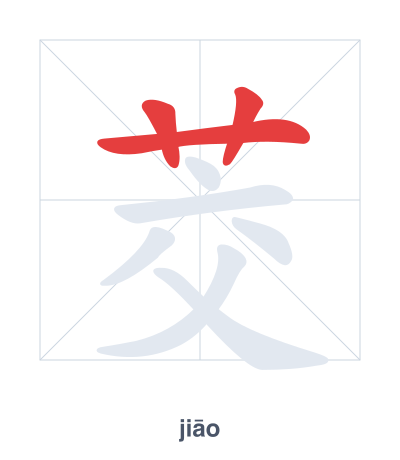
Open Hanzi Writer to see the animated stroke order and practice writing 茭 with real-time feedback.
The character 茭 (jiāo) is written with 9 strokes. Follow the standard Chinese stroke order: top to bottom, left to right, outside before inside. The radical 艹 is one of its key components.
Practice the correct stroke order with the Hanzi Writer app to see animated stroke-by-stroke guidance with real-time feedback.
茭 means water bamboo.
茭 is a phono-semantic compound formed by the grass radical 艹 (indicating it is a plant) and the phonetic component 交 (jiāo, meaning 'to cross' or 'intersect'). The character refers to water bamboo, an aquatic grass with jointed stems that resemble intersecting nodes, visually reinforced by 交.
💡 Memory Tip: Imagine a patch of grass (艹) growing at the intersection (交) of a stream and a pond, where water bamboo thrives.
我喜欢吃炒茭白。
wǒ xǐ huān chī chǎo jiāo bái
I like eating stir-fried wild rice stems.
河边长满了茭草。
hé biān zhǎng mǎn le jiāo cǎo
The riverside is covered with wild rice grass.
茭笋味道很清甜。
jiāo sǔn wèi dào hěn qīng tián
Water bamboo shoots taste very sweet and fresh.
Open Hanzi Writer to see the animated stroke order and practice writing 茭 with real-time feedback.
✨ Animated stroke order · Handwriting recognition · HSK-graded practice · Free to use
茭 is composed of the radical 艹 (grass) on top and the phonetic component 交 (jiāo) below. The grass radical indicates that the character relates to plants, and 交 hints at the pronunciation. Together, they represent a type of aquatic grass or vegetable, specifically water bamboo.