胛 (jiǎ) means "Shoulder blade" in Chinese. It has 9 strokes with the radical 月.
Rated 4/5 in difficulty (challenging).
Appears in 3+ common words including 肩胛骨 (jiān jiǎ gǔ), 肩胛 (jiān jiǎ), 胛子 (jiǎ zi).
Due to its 9 strokes, Hanzi Writer's error detection shows 胛 requires focused practice — most learners need 10+ attempts for consistent accuracy.
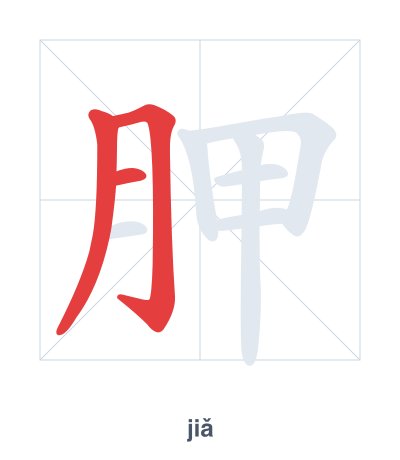
Open Hanzi Writer to see the animated stroke order and practice writing 胛 with real-time feedback.
The character 胛 (jiǎ) is written with 9 strokes. Follow the standard Chinese stroke order: top to bottom, left to right, outside before inside. The radical 月 is one of its key components.
Practice the correct stroke order with the Hanzi Writer app to see animated stroke-by-stroke guidance with real-time feedback.
胛 means Shoulder blade.
The character 胛 combines the flesh radical 月 (meat/flesh) with 甲 (armor or shell), indicating the shoulder blade bone that is flat and protective like a piece of armor. In ancient Chinese, the shoulder blade was seen as a bony shield for the upper back, hence the visual connection to armor.
💡 Memory Tip: Picture a shoulder blade (月) wearing a piece of armor (甲) on your back to remember it as the flat, shield-like bone.
他的肩胛骨受伤了。
tā de jiān jiǎ gǔ shòu shāng le
His shoulder blade is injured.
他的肩胛很宽。
tā de jiān jiǎ hěn kuān
His shoulder blades are very wide.
猪胛子肉很好吃。
zhū jiǎ zi ròu hěn hǎo chī
Pork shoulder meat is very delicious.
Open Hanzi Writer to see the animated stroke order and practice writing 胛 with real-time feedback.
✨ Animated stroke order · Handwriting recognition · HSK-graded practice · Free to use
胛 is made of two parts: the left radical 月 (flesh or body part) and the right component 甲 (armor or shell). The radical indicates it relates to the body, and 甲 suggests a flat, hard shape like armor, perfectly matching the shoulder blade's bone.