蓟 (jì) means "thistle" in Chinese. It has 13 strokes with the radical 艹.
Rated 4.2/5 in difficulty (advanced).
Appears in 3+ common words including 大蓟 (dà jì), 蓟县 (jì xiàn), 小蓟 (xiǎo jì).
Due to its 13 strokes, Hanzi Writer's error detection shows 蓟 requires focused practice — most learners need 10+ attempts for consistent accuracy.
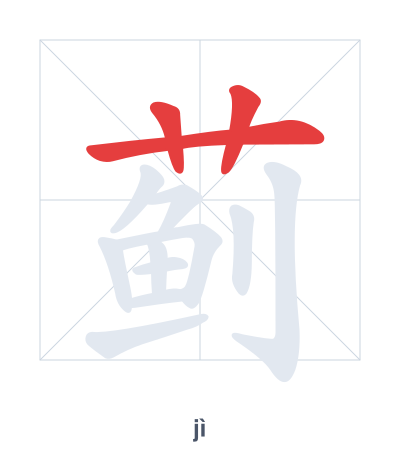
Open Hanzi Writer to see the animated stroke order and practice writing 蓟 with real-time feedback.
The character 蓟 (jì) is written with 13 strokes. Follow the standard Chinese stroke order: top to bottom, left to right, outside before inside. The radical 艹 is one of its key components.
Practice the correct stroke order with the Hanzi Writer app to see animated stroke-by-stroke guidance with real-time feedback.
蓟 means thistle.
蓟 is a phono-semantic compound: the radical 艹 (grass) indicates it is a plant, while the phonetic component 㕚 (resembling a claw) hints at the thistle’s prickly thorns.
💡 Memory Tip: Imagine a thistle plant where the grass (艹) has a sharp claw (㕚) that pricks you if you touch it.
大蓟是一种中药。
dà jì shì yī zhǒng zhōng yào
Japanese thistle is a type of traditional Chinese medicine.
他打算去蓟县旅游。
tā dǎ suàn qù jì xiàn lǚ yóu
He plans to travel to Jixian.
地里长了很多小蓟。
dì lǐ zhǎng le hěn duō xiǎo jì
Many field thistles are growing in the field.
Open Hanzi Writer to see the animated stroke order and practice writing 蓟 with real-time feedback.
✨ Animated stroke order · Handwriting recognition · HSK-graded practice · Free to use
蓟 has the radical 艹 (grass) on top, indicating it is a plant. The bottom part is 契, which originally relates to cutting or carving, reflecting the thistle's sharp, prickly leaves. Together, they form the meaning of thistle, a spiny plant.