伎 (jì) means "Skill or trick" in Chinese. It has 6 strokes with the radical 亻.
Rated 2.9/5 in difficulty (moderate).
Appears in 3+ common words including 伎俩 (jì liǎng), 伎艺 (jì yì), 歌伎 (gē jì).
Hanzi Writer's stroke validation shows learners typically need 5-8 attempts to write 伎 with correct proportion and order.
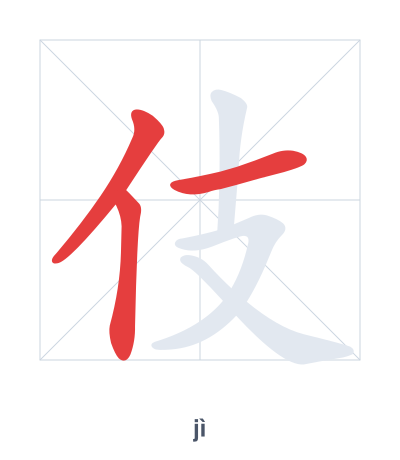
Open Hanzi Writer to see the animated stroke order and practice writing 伎 with real-time feedback.
The character 伎 (jì) is written with 6 strokes. Follow the standard Chinese stroke order: top to bottom, left to right, outside before inside. The radical 亻 is one of its key components.
Practice the correct stroke order with the Hanzi Writer app to see animated stroke-by-stroke guidance with real-time feedback.
伎 means Skill or trick.
The character 伎 combines 'person' (亻) and 'branch' (支), originally depicting a skilled performer using a branch as a prop, later generalized to any skill or cunning trick.
💡 Memory Tip: Picture a person (亻) holding a branch (支) and performing a clever balancing trick with it.
别用这种小伎俩。
bié yòng zhè zhǒng xiǎo jì liǎng
Don't use these little tricks.
他的伎艺很精湛。
tā de jì yì hěn jīng zhàn
His skills are superb.
这是一个歌伎。
zhè shì yí gè gē jì
This is a singing girl.
Open Hanzi Writer to see the animated stroke order and practice writing 伎 with real-time feedback.
✨ Animated stroke order · Handwriting recognition · HSK-graded practice · Free to use
伎 is composed of the radical 亻 (person) on the left, and 支 (zhī, branch or support) on the right. The person radical suggests actions or skills performed by people, while 支 adds the idea of "branching out" or "maneuvering," together forming the concept of a person's skill or trick.