蕺 (jí) means "houttuynia (fish mint)" in Chinese. It has 15 strokes with the radical 艹.
Rated 4.2/5 in difficulty (advanced).
Appears in 3+ common words including 蕺菜 (jí cài), 采蕺 (cǎi jí), 蕺山 (jí shān).
Due to its 15 strokes, Hanzi Writer's error detection shows 蕺 requires focused practice — most learners need 10+ attempts for consistent accuracy.
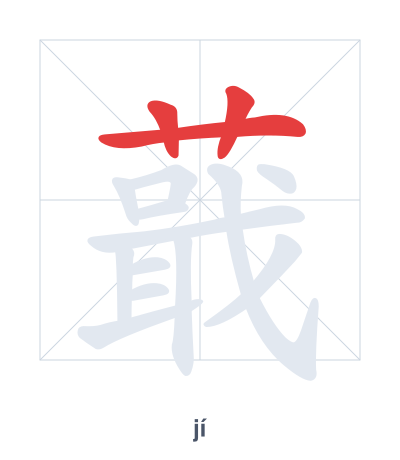
Open Hanzi Writer to see the animated stroke order and practice writing 蕺 with real-time feedback.
The character 蕺 (jí) is written with 15 strokes. Follow the standard Chinese stroke order: top to bottom, left to right, outside before inside. The radical 艹 is one of its key components.
Practice the correct stroke order with the Hanzi Writer app to see animated stroke-by-stroke guidance with real-time feedback.
蕺 means houttuynia (fish mint).
蕺 is a phono-semantic compound: the radical 艹 (grass) indicates it's a plant, while 耤 (jí) provides the sound. 耤 itself combines 耒 (plow) and 昔 (ancient), but here it mainly acts as a phonetic hint. The character refers to houttuynia, a herb with a distinctive fishy smell, often used in Asian cuisine.
💡 Memory Tip: Picture an ancient plow (耒) covered in grass (艹) that smells like rotten fish—that's the 蕺 plant, growing wild in old fields.
这种蕺菜很新鲜。
zhè zhǒng jí cài hěn xīn xiān
This fish mint is very fresh.
农民在田里采蕺。
nóng mín zài tián lǐ cǎi jí
Farmers are picking heartleaf in the field.
蕺山在浙江绍兴。
jí shān zài zhè jiāng shào xīng
Jishan is in Shaoxing, Zhejiang.
Open Hanzi Writer to see the animated stroke order and practice writing 蕺 with real-time feedback.
✨ Animated stroke order · Handwriting recognition · HSK-graded practice · Free to use
蕺 has the radical 艹 (grass) on top, indicating it is a type of plant. Below is 揤 (jí), which gives the pronunciation but also suggests the idea of "pressing" or "gathering," hinting at how fish mint is often collected.