镬 (huò) means "Cauldron / Large pot" in Chinese. It has 18 strokes with the radical 钅.
Rated 4.2/5 in difficulty (advanced).
Appears in 3+ common words including 镬子 (huò zi), 鼎镬 (dǐng huò), 镬盖 (huò gài).
Due to its 18 strokes, Hanzi Writer's error detection shows 镬 requires focused practice — most learners need 10+ attempts for consistent accuracy.
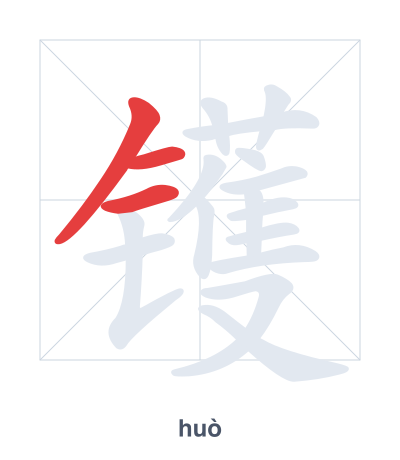
Open Hanzi Writer to see the animated stroke order and practice writing 镬 with real-time feedback.
The character 镬 (huò) is written with 18 strokes. Follow the standard Chinese stroke order: top to bottom, left to right, outside before inside. The radical 钅 is one of its key components.
Practice the correct stroke order with the Hanzi Writer app to see animated stroke-by-stroke guidance with real-time feedback.
镬 means Cauldron / Large pot.
This character is a phono-semantic compound: the radical 钅 (metal) indicates the material, while 蒦 (huò) provides the pronunciation and originally related to harvesting or measuring. Together they form a large metal pot used for cooking in ancient China.
💡 Memory Tip: Imagine a metal cauldron (钅) so big that a bird (隹) nests on the rim while a hand (又) tosses in grass (艹) for the fire.
厨师在镬子里炒菜。
chú shī zài huò zi lǐ chǎo cài
The chef is stir-frying in the large pot.
这是古代的一种鼎镬。
zhè shì gǔ dài de yī zhǒng dǐng huò
This is a type of ancient cauldron.
请把镬盖盖好。
qǐng bǎ huò gài gài hǎo
Please put the lid on the wok properly.
Open Hanzi Writer to see the animated stroke order and practice writing 镬 with real-time feedback.
✨ Animated stroke order · Handwriting recognition · HSK-graded practice · Free to use
镬 is made of the radical 钅 (metal) on the left and the phonetic component 蒦 on the right. The metal radical shows it is a metal object, and the right part gives a clue to its pronunciation huò, though not its meaning. Together, they form a character for a large metal pot or cauldron used for cooking or boiling.