缋 (huì) means "to draw / to paint / multi-colored" in Chinese. It has 12 strokes with the radical 纟.
Rated 4.2/5 in difficulty (advanced).
Appears in 3+ common words including 缋画 (huì huà), 缋纯 (huì chún), 绣缋 (xiù huì).
Due to its 12 strokes, Hanzi Writer's error detection shows 缋 requires focused practice — most learners need 10+ attempts for consistent accuracy.
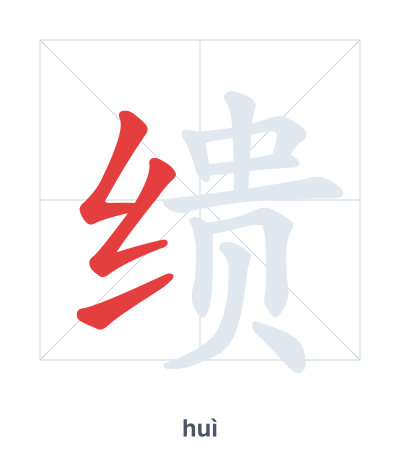
Open Hanzi Writer to see the animated stroke order and practice writing 缋 with real-time feedback.
The character 缋 (huì) is written with 12 strokes. Follow the standard Chinese stroke order: top to bottom, left to right, outside before inside. The radical 纟 is one of its key components.
Practice the correct stroke order with the Hanzi Writer app to see animated stroke-by-stroke guidance with real-time feedback.
缋 means to draw / to paint / multi-colored.
The character 缋 combines the silk radical 纟 with 贵 (expensive), reflecting the practice of painting or embroidering costly, multi-colored patterns on silk fabric. The left side indicates the material (silk), while the right side hints at the preciousness of the decorated textile.
💡 Memory Tip: Picture an expensive (贵) silk scarf (纟) being hand-painted with a riot of colors, turning it into a masterpiece of multi-colored art.
墙上有精美的缋画。
qiáng shàng yǒu jīng měi de huì huà
There are exquisite paintings on the wall.
缋纯是古代的服饰。
huì chún shì gǔ dài de fú shì
Hui-chun is a type of ancient clothing decoration.
绣缋工艺非常复杂。
xiù huì gōng yì fēi cháng fù zá
The craft of embroidery and painting is very complex.
Open Hanzi Writer to see the animated stroke order and practice writing 缋 with real-time feedback.
✨ Animated stroke order · Handwriting recognition · HSK-graded practice · Free to use
缋 is made of the radical 纟 (silk) on the left and 贵 (expensive) on the right. The silk radical connects to textiles and threads, while 贵 provides a phonetic hint and suggests value. Together they create the meanings "to draw/paint" (as in painting on silk) and "multi-colored" (like rich embroidery).