肓 (huāng) means "region between the heart and diaphragm (in TCM)" in Chinese. It has 7 strokes with the radical 月.
Rated 3.5/5 in difficulty (challenging).
Appears in 3+ common words including 病入膏肓 (bìng rù gāo huāng), 膏肓 (gāo huāng), 肓穴 (huāng xué).
Due to its 7 strokes, Hanzi Writer's error detection shows 肓 requires focused practice — most learners need 10+ attempts for consistent accuracy.
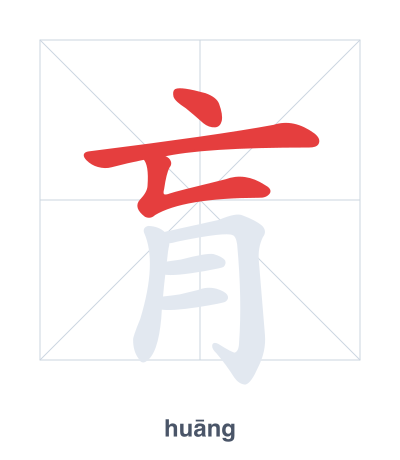
Open Hanzi Writer to see the animated stroke order and practice writing 肓 with real-time feedback.
The character 肓 (huāng) is written with 7 strokes. Follow the standard Chinese stroke order: top to bottom, left to right, outside before inside. The radical 月 is one of its key components.
Practice the correct stroke order with the Hanzi Writer app to see animated stroke-by-stroke guidance with real-time feedback.
肓 means region between the heart and diaphragm (in TCM).
肓 combines the flesh radical 月 with 亡 (wáng, 'death' or 'lost'), symbolizing a hidden vital region between the heart and diaphragm where disease is difficult to treat and can be fatal.
💡 Memory Tip: Imagine a blind spot (亡) inside your chest (月) where the heart and diaphragm meet—a dangerous area you'd rather forget.
他已经病入膏肓。
tā yǐ jīng bìng rù gāo huāng
His illness is terminal and beyond cure.
病在膏肓难治。
bìng zài gāo huāng nán zhì
The illness is deep-seated and hard to cure.
医生在找肓穴。
yī shēng zài zhǎo huāng xué
The doctor is locating the Huang acupuncture point.
Open Hanzi Writer to see the animated stroke order and practice writing 肓 with real-time feedback.
✨ Animated stroke order · Handwriting recognition · HSK-graded practice · Free to use
The character 肓 is made of two parts: the left radical 月 (meaning "flesh" or "body") and the right component 亡 (wáng, meaning "to disappear" or "hidden"). Together, they suggest a hidden area of the body — specifically, the region between the heart and diaphragm in traditional Chinese medicine.