郇 (huán) means "Xun (a surname)" in Chinese. It has 8 strokes with the radical 阝.
Rated 3.4/5 in difficulty (challenging).
Appears in 3+ common words including 郇先生 (huán xiān shēng), 郇厨 (huán chú), 姓郇 (xìng huán).
Due to its 8 strokes, Hanzi Writer's error detection shows 郇 requires focused practice — most learners need 10+ attempts for consistent accuracy.
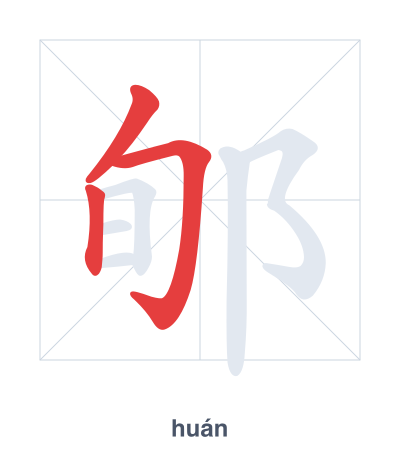
Open Hanzi Writer to see the animated stroke order and practice writing 郇 with real-time feedback.
The character 郇 (huán) is written with 8 strokes. Follow the standard Chinese stroke order: top to bottom, left to right, outside before inside. The radical 阝 is one of its key components.
Practice the correct stroke order with the Hanzi Writer app to see animated stroke-by-stroke guidance with real-time feedback.
郇 means Xun (a surname).
郇 combines the phonetic component 旬 (xún, meaning a ten-day cycle) with the radical 阝 (representing a city or state), indicating a place name. It originally referred to an ancient state during the Zhou dynasty, located in present-day Shanxi, and later became a surname.
💡 Memory Tip: Picture a city wall (阝) where every ten days (旬) a messenger named Xun arrives with the sun (日) wrapped in a cloth (勹).
郇先生喜欢喝茶。
huán xiān shēng xǐ huān hē chá
Mr. Xun likes to drink tea.
这里的菜有郇厨之风。
zhè lǐ de cài yǒu huán chú zhī fēng
The food here has the style of a gourmet kitchen.
我的好朋友姓郇。
wǒ de hǎo péng yǒu xìng huán
My best friend's surname is Xun.
Open Hanzi Writer to see the animated stroke order and practice writing 郇 with real-time feedback.
✨ Animated stroke order · Handwriting recognition · HSK-graded practice · Free to use
The character 郇 is made of two parts: the left radical 阝 (meaning 'city' or 'place') and the right part 旬 (meaning 'ten-day period'). Originally it referred to a place name, and now it is mainly used as a surname.