觳 (hú) means "ancient measure; to tremble" in Chinese. It has 17 strokes with the radical 角.
Rated 4.2/5 in difficulty (advanced).
Appears in 2+ common words including 觳觫 (hú sù), 觳抵 (hú dǐ).
Due to its 17 strokes, Hanzi Writer's error detection shows 觳 requires focused practice — most learners need 10+ attempts for consistent accuracy.
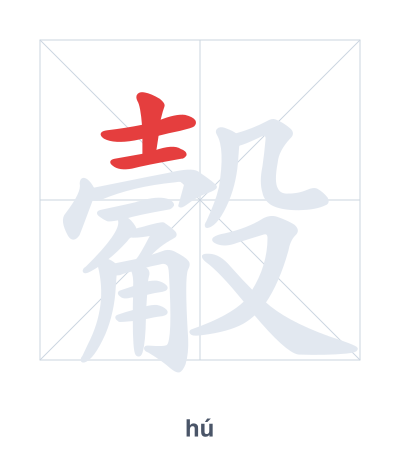
Open Hanzi Writer to see the animated stroke order and practice writing 觳 with real-time feedback.
The character 觳 (hú) is written with 17 strokes. Follow the standard Chinese stroke order: top to bottom, left to right, outside before inside. The radical 角 is one of its key components.
Practice the correct stroke order with the Hanzi Writer app to see animated stroke-by-stroke guidance with real-time feedback.
觳 means ancient measure; to tremble.
| Character | 觳 |
| Pinyin | hú (hu) |
| Meaning | ancient measure; to tremble |
| Strokes | 17 |
| Radical | 角 |
| Difficulty | 4.2/5 |
The character 觳 combines 角 (horn) with 殳 (hand holding a weapon). Originally it referred to an ancient grain measure made of horn, but the same image of a horn struck by a weapon evokes trembling in fear.
💡 Memory Tip: Picture a horn (角) being struck by a hand holding a mallet (殳), making the whole thing tremble violently.
牛感到觳觫。
niú gǎn dào hú sù
The ox is trembling with fear.
他们在玩觳抵。
tā men zài wán hú dǐ
They are wrestling.
他吓得觳觫。
tā xià dé hú sù
He trembled with fear.
Open Hanzi Writer to see the animated stroke order and practice writing 觳 with real-time feedback.
✨ Animated stroke order · Handwriting recognition · HSK-graded practice · Free to use
觳 is composed of the radical 角 (horn) on the left and 殳 (a hand holding a weapon) on the right. The combination suggests a horn being struck, which connects to the meaning 'to tremble' — like trembling from an impact. The ancient measure meaning may come from using animal horns as measuring containers.