觱 (bì) means "ancient flute; cold wind" in Chinese. It has 16 strokes with the radical 角.
Rated 4.2/5 in difficulty (advanced).
Appears in 3+ common words including 觱篥 (bì lì), 觱发 (bì fā), 觱沸 (bì fèi).
Due to its 16 strokes, Hanzi Writer's error detection shows 觱 requires focused practice — most learners need 10+ attempts for consistent accuracy.
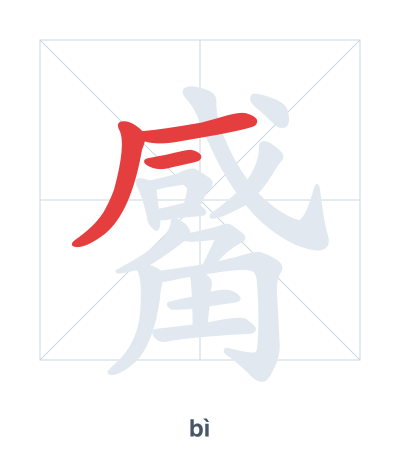
Open Hanzi Writer to see the animated stroke order and practice writing 觱 with real-time feedback.
The character 觱 (bì) is written with 16 strokes. Follow the standard Chinese stroke order: top to bottom, left to right, outside before inside. The radical 角 is one of its key components.
Practice the correct stroke order with the Hanzi Writer app to see animated stroke-by-stroke guidance with real-time feedback.
觱 means ancient flute; cold wind.
| Character | 觱 |
| Pinyin | bì (bi) |
| Meaning | ancient flute; cold wind |
| Strokes | 16 |
| Radical | 角 |
| Difficulty | 4.2/5 |
觱 combines 角 (horn) as a semantic clue that the ancient flute was made from animal horn, with a phonetic component on the right (㕁) that hints at the sound bì. The character originally referred to a horn flute used in ritual music, and later came to describe a cold, piercing wind, perhaps because of the shrill sound it makes.
💡 Memory Tip: Picture a horn (角) with a crack (㕁) that, when blown, releases a freezing gust of wind (bì).
他在吹觱篥。
tā zài chuī bì lì
He is playing the bili.
寒风觱发。
hán fēng bì fā
The cold wind whistles and blows.
泉水觱沸。
quán shuǐ bì fèi
The spring water gushes out forcefully.
Open Hanzi Writer to see the animated stroke order and practice writing 觱 with real-time feedback.
✨ Animated stroke order · Handwriting recognition · HSK-graded practice · Free to use
觱 is composed of the radical 角 (horn/angle) and the phonetic component 弻 (bì, meaning "to recurve a bow"). The radical 角 hints at the character's connection to a horn or wind instrument, while the phonetic 弻 gives the pronunciation bì and reinforces the idea of a curved shape, like an ancient flute.