蚵 (hé) means "Oyster" in Chinese. It has 11 strokes with the radical 虫.
Rated 4.2/5 in difficulty (advanced).
Appears in 3+ common words including 蚵仔煎 (hé zǎi jiān), 蚵仔 (hé zǎi), 蚵壳 (hé ké).
Due to its 11 strokes, Hanzi Writer's error detection shows 蚵 requires focused practice — most learners need 10+ attempts for consistent accuracy.
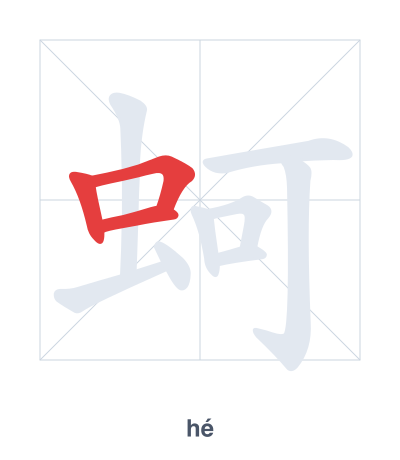
Open Hanzi Writer to see the animated stroke order and practice writing 蚵 with real-time feedback.
The character 蚵 (hé) is written with 11 strokes. Follow the standard Chinese stroke order: top to bottom, left to right, outside before inside. The radical 虫 is one of its key components.
Practice the correct stroke order with the Hanzi Writer app to see animated stroke-by-stroke guidance with real-time feedback.
蚵 means Oyster.
蚵 is a phono-semantic compound: the radical 虫 (originally 'insect' but extended to shellfish) indicates it's a mollusk, while 可 (kě) provides the sound hé. Oysters are bivalve mollusks commonly farmed for food and pearls. The character combines 'shellfish' with a phonetic clue to form the word for 'oyster'.
💡 Memory Tip: Imagine a tiny insect (虫) sitting on a giant oyster shell, nodding 'okay' (可) as it enjoys the tasty oyster inside.
我想吃一份蚵仔煎。
wǒ xiǎng chī yī fèn hé zǎi jiān
I want to eat an oyster omelet.
这里的蚵仔很新鲜。
zhè lǐ de hé zǎi hěn xīn xiān
The oysters here are very fresh.
沙滩上有很多蚵壳。
shā tān shàng yǒu hěn duō hé ké
There are many oyster shells on the beach.
Open Hanzi Writer to see the animated stroke order and practice writing 蚵 with real-time feedback.
✨ Animated stroke order · Handwriting recognition · HSK-graded practice · Free to use
The character 蚵 is made of the radical 虫 (insect or small creature) on the left and 可 on the right. The radical 虫 hints that the character refers to a small sea creature, while 可 provides the pronunciation hé. So the structure combines a meaning component (虫) and a sound component (可).