涸 (hé) means "To dry up" in Chinese. It has 11 strokes with the radical 氵.
Rated 4.2/5 in difficulty (advanced).
Appears in 3+ common words including 干涸 (gān hé), 涸竭 (hé jié), 涸 (hé).
Due to its 11 strokes, Hanzi Writer's error detection shows 涸 requires focused practice — most learners need 10+ attempts for consistent accuracy.
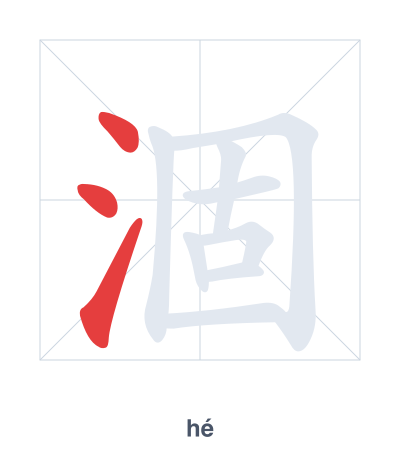
Open Hanzi Writer to see the animated stroke order and practice writing 涸 with real-time feedback.
The character 涸 (hé) is written with 11 strokes. Follow the standard Chinese stroke order: top to bottom, left to right, outside before inside. The radical 氵 is one of its key components.
Practice the correct stroke order with the Hanzi Writer app to see animated stroke-by-stroke guidance with real-time feedback.
涸 means To dry up.
涸 is a phono-semantic compound where 氵 (water) indicates the meaning, and 固 (gù, meaning 'solid' or 'firm') provides the sound and hints at the result—when water dries up, the ground becomes hard and fixed. The character thus visually shows water transforming into a solid, dry state.
💡 Memory Tip: Imagine water (氵) gets trapped inside a solid block (固) and dries up completely.
由于缺水,河道干涸了。
yóu yú quē shuǐ hé dào gān hé le
Due to the lack of water, the riverbed has dried up.
这里的资源已经涸竭了。
zhè lǐ de zī yuán yǐ jīng hé jié le
The resources here have been exhausted.
这口井已经涸了很久。
zhè kǒu jǐng yǐ jīng hé le hěn jiǔ
This well has been dry for a long time.
Open Hanzi Writer to see the animated stroke order and practice writing 涸 with real-time feedback.
✨ Animated stroke order · Handwriting recognition · HSK-graded practice · Free to use
涸 is made of the water radical 氵 on the left and the component 固 (meaning solid or firm) on the right. Together they suggest water becoming solid or fixed, which leads to drying up. This structural combination directly expresses the idea of water being exhausted.