呙 (guō) means "slanted / crooked (rarely used alone)" in Chinese. It has 7 strokes with the radical 口.
Rated 3.5/5 in difficulty (challenging).
Appears in 3+ common words including 姓呙 (xìng guō), 歪呙 (wāi guō), 呙斜 (guō xié).
Due to its 7 strokes, Hanzi Writer's error detection shows 呙 requires focused practice — most learners need 10+ attempts for consistent accuracy.
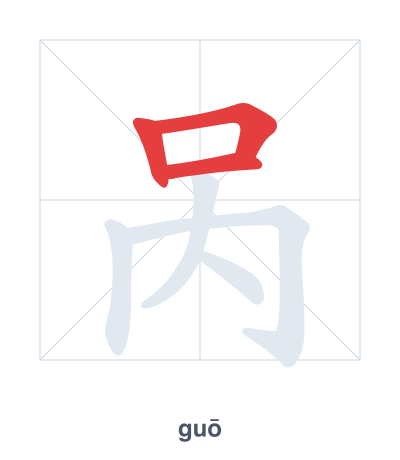
Open Hanzi Writer to see the animated stroke order and practice writing 呙 with real-time feedback.
The character 呙 (guō) is written with 7 strokes. Follow the standard Chinese stroke order: top to bottom, left to right, outside before inside. The radical 口 is one of its key components.
Practice the correct stroke order with the Hanzi Writer app to see animated stroke-by-stroke guidance with real-time feedback.
呙 means slanted / crooked (rarely used alone).
呙 is a pictograph of a slanted or crooked mouth. Its ancient form depicted an open mouth with a twisted or skewed shape, emphasizing something askew. The radical 口 (mouth) reinforces the visual of a crooked opening.
💡 Memory Tip: Imagine a mouth (口) with a diagonal crack running through it, making it permanently slanted and crooked.
他姓呙。
tā xìng guō
His surname is Guo.
他的嘴歪呙了。
tā de zuǐ wāi guō le
His mouth is twisted.
墙面有点呙斜。
qiáng miàn yǒu diǎn guō xié
The wall surface is a bit crooked.
Open Hanzi Writer to see the animated stroke order and practice writing 呙 with real-time feedback.
✨ Animated stroke order · Handwriting recognition · HSK-graded practice · Free to use
呙 is made of the radical 口 (mouth) on top and a bottom part 冎 that looks like a slanted or crooked shape. Together, they suggest a mouth that is twisted or crooked, which matches the meaning of being slanted or crooked.