晷 (guǐ) means "Sundial / Time" in Chinese. It has 12 strokes with the radical 日.
Rated 4.2/5 in difficulty (advanced).
Appears in 3+ common words including 日晷 (rì guǐ), 晷针 (guǐ zhēn), 晷刻 (guǐ kè).
Due to its 12 strokes, Hanzi Writer's error detection shows 晷 requires focused practice — most learners need 10+ attempts for consistent accuracy.
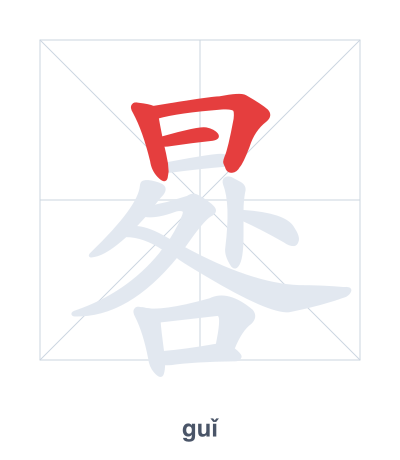
Open Hanzi Writer to see the animated stroke order and practice writing 晷 with real-time feedback.
The character 晷 (guǐ) is written with 12 strokes. Follow the standard Chinese stroke order: top to bottom, left to right, outside before inside. The radical 日 is one of its key components.
Practice the correct stroke order with the Hanzi Writer app to see animated stroke-by-stroke guidance with real-time feedback.
晷 means Sundial / Time.
晷 combines the sun radical 日 with 咎 as a phonetic component (pronounced guǐ). The sun radical indicates that a sundial measures time by the sun's shadow, which was the original meaning of the character.
💡 Memory Tip: Picture the sun (日) casting a shadow on a sundial; if you misread it, you'll be at fault (咎) for being late.
故宫里有一个日晷。
gù gōng lǐ yǒu yí gè rì guǐ
There is a sundial in the Forbidden City.
日晷的晷针指向北方。
rì guǐ de guǐ zhēn zhǐ xiàng běi fāng
The gnomon of the sundial points north.
晷刻记录了时间的变化。
guǐ kè jì lù le shí jiān de biàn huà
The sundial marks record the passage of time.
Open Hanzi Writer to see the animated stroke order and practice writing 晷 with real-time feedback.
✨ Animated stroke order · Handwriting recognition · HSK-graded practice · Free to use
晷 is made of two parts: the top is 日 (sun) and the bottom is 咎 (guǐ, which gives the sound). The 日 radical shows that a sundial depends on the sun to cast a shadow. The combination creates the meaning of a sundial or time measured by the sun.