胱 (guāng) means "bladder; cystine-related" in Chinese. It has 10 strokes with the radical 月.
Rated 4.2/5 in difficulty (advanced).
Appears in 3+ common words including 膀胱 (páng guāng), 膀胱炎 (páng guāng yán), 膀胱镜 (páng guāng jìng).
Due to its 10 strokes, Hanzi Writer's error detection shows 胱 requires focused practice — most learners need 10+ attempts for consistent accuracy.
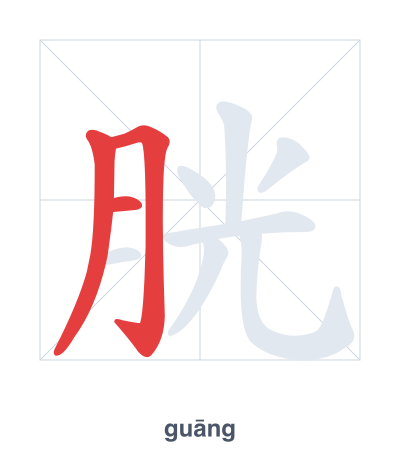
Open Hanzi Writer to see the animated stroke order and practice writing 胱 with real-time feedback.
The character 胱 (guāng) is written with 10 strokes. Follow the standard Chinese stroke order: top to bottom, left to right, outside before inside. The radical 月 is one of its key components.
Practice the correct stroke order with the Hanzi Writer app to see animated stroke-by-stroke guidance with real-time feedback.
胱 means bladder; cystine-related.
胱 is a phono-semantic compound where 月 (flesh/body) indicates it's a body part, and 光 (guāng, meaning 'light') provides the pronunciation. It originally referred to the bladder as part of the urinary system, often paired with 膀 in 膀胱 (bladder).
💡 Memory Tip: Picture a glowing (光) body part (月) that swells like a water balloon — your bladder.
憋尿对膀胱不好。
biē niào duì páng guāng bù hǎo
Holding in urine is bad for the bladder.
喝水少容易得膀胱炎。
hē shuǐ shǎo róng yì dé páng guāng yán
Drinking too little water can easily lead to cystitis.
医生在做膀胱镜检查。
yī shēng zài zuò páng guāng jìng jiǎn chá
The doctor is performing a cystoscopy.
Open Hanzi Writer to see the animated stroke order and practice writing 胱 with real-time feedback.
✨ Animated stroke order · Handwriting recognition · HSK-graded practice · Free to use
胱 is made of two parts: the radical 月 (meat/flesh) on the left and 光 (light) on the right. The 月 radical shows that the character relates to a body part, while 光 gives the pronunciation guāng. Together they form the word for 'bladder', a body organ.