袼 (gē) means "Armpit of a garment" in Chinese. It has 11 strokes with the radical 衤.
Rated 4.2/5 in difficulty (advanced).
Appears in 3+ common words including 袼褙 (gē bèi), 袼褙儿 (gē bèi ér), 做袼褙 (zuò gē bèi).
Due to its 11 strokes, Hanzi Writer's error detection shows 袼 requires focused practice — most learners need 10+ attempts for consistent accuracy.
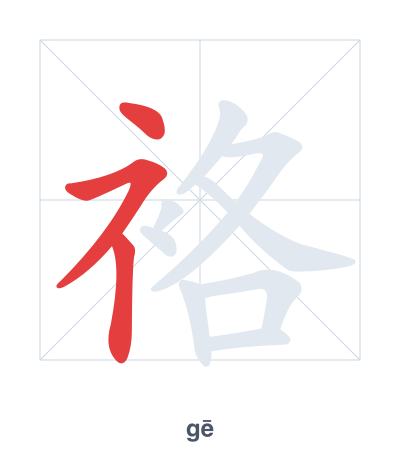
Open Hanzi Writer to see the animated stroke order and practice writing 袼 with real-time feedback.
The character 袼 (gē) is written with 11 strokes. Follow the standard Chinese stroke order: top to bottom, left to right, outside before inside. The radical 衤 is one of its key components.
Practice the correct stroke order with the Hanzi Writer app to see animated stroke-by-stroke guidance with real-time feedback.
袼 means Armpit of a garment.
袼 is a phono-semantic compound where the radical 衤 (clothing) indicates the meaning—a part of a garment—and the component 各 (gè) provides a phonetic hint (though the pronunciation shifted to gē). The character specifically refers to the armpit section of a sleeve, the area where the garment fits under the arm.
💡 Memory Tip: Picture a shirt (衤) with a big, sweaty armpit hole that each (各) arm must squeeze through.
妈妈在糊袼褙。
mā mā zài hú gē bèi
Mom is pasting layers of cloth together.
袼褙儿可以做鞋底。
gē bèi ér kě yǐ zuò xié dǐ
Pasted cloth layers can be used to make shoe soles.
这是旧布做的袼褙。
zhè shì jiù bù zuò de gē bèi
This is pasteboard made from old cloth scraps.
Open Hanzi Writer to see the animated stroke order and practice writing 袼 with real-time feedback.
✨ Animated stroke order · Handwriting recognition · HSK-graded practice · Free to use
袼 is composed of the radical 衤 (clothing) on the left and 各 (gè, meaning 'each') on the right. The clothing radical shows that 袼 relates to garments, while 各 primarily provides the pronunciation gē. Together, they form the meaning 'armpit of a garment'—the part of clothing that fits under the arm.