Hanzi Writer

How to Write 藁 (gǎo) — Meaning “Straw / Draft”

gǎo 17 strokes Radical: 艹

藁 (gǎo) means "Straw / Draft" in Chinese. It has 17 strokes with the radical 艹.

Rated 4.2/5 in difficulty (advanced).

Appears in 3+ common words including 藁本 (gǎo běn), 枯藁 (kū gǎo), 藁席 (gǎo xí).

Due to its 17 strokes, Hanzi Writer's error detection shows 藁 requires focused practice — most learners need 10+ attempts for consistent accuracy.
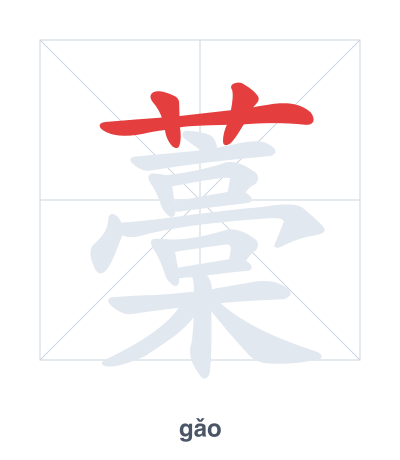
Stroke order practice for 藁 - gǎo

Practice Writing 藁 (gǎo)

Open Hanzi Writer to see the animated stroke order and practice writing 藁 with real-time feedback.

The character (gǎo) is written with 17 strokes. Follow the standard Chinese stroke order: top to bottom, left to right, outside before inside. The radical is one of its key components.

Practice the correct stroke order with the Hanzi Writer app to see animated stroke-by-stroke guidance with real-time feedback.

means Straw / Draft.

Character
Pinyingǎo (gao)
MeaningStraw / Draft
Strokes17
Radical
Difficulty4.2/5

藁 combines the grass radical 艹 with 槀, which itself depicts a tall (高) tree (木) that has withered, together meaning dried straw or withered grass. The meaning 'draft' (as in a manuscript) is a later borrowed usage, perhaps from the idea of rough, straw-like preliminary notes.

💡 Memory Tip: Imagine a tall straw man (艹 on top, 高-like shape) leaning on a wooden table (木 below), scribbling a rough draft with a piece of straw.

gǎo běn
Ligusticum (Chinese lovage)
kū gǎo
withered; dried up
gǎo xí
Straw mat

藁本可以用来治感冒。

gǎo běn kě yǐ yòng lái zhì gǎn mào

Ligusticum can be used to treat colds.

秋天草木都枯藁了。

qiū tiān cǎo mù dōu kū gǎo le

In autumn, the plants and trees have withered.

他睡在简陋的藁席上。

tā shuì zài jiǎn lòu de gǎo xí shàng

He slept on a simple straw mat.

Character Pinyin Strokes Radical
(current) gǎo 17
shū 15
fān 15
xùn 15
Stroke order practice for 藁 - gǎo

Practice Writing 藁 (gǎo)

Open Hanzi Writer to see the animated stroke order and practice writing 藁 with real-time feedback.

✨ Animated stroke order · Handwriting recognition · HSK-graded practice · Free to use

Frequently Asked Questions about 藁

藁 is composed of the grass radical 艹 on top and the phonetic component 槁 (gǎo, meaning withered) below. The grass radical connects to the plant-related meanings like straw and withered grass, while the lower part indicates the pronunciation.

Characters with Radical 艹

Other 17-Stroke Characters