槀 (gǎo) means "Withered or straw" in Chinese. It has 14 strokes with the radical 木.
Rated 4.2/5 in difficulty (advanced).
Appears in 3+ common words including 槀木 (gǎo mù), 枯槀 (kū gǎo), 槀草 (gǎo cǎo).
Due to its 14 strokes, Hanzi Writer's error detection shows 槀 requires focused practice — most learners need 10+ attempts for consistent accuracy.
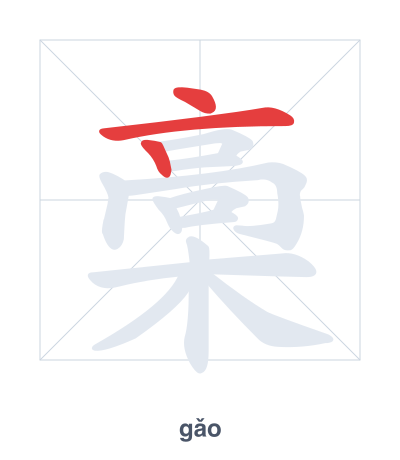
Open Hanzi Writer to see the animated stroke order and practice writing 槀 with real-time feedback.
The character 槀 (gǎo) is written with 14 strokes. Follow the standard Chinese stroke order: top to bottom, left to right, outside before inside. The radical 木 is one of its key components.
Practice the correct stroke order with the Hanzi Writer app to see animated stroke-by-stroke guidance with real-time feedback.
槀 means Withered or straw.
槀 is a compound character combining 木 (tree) and 高 (high/tall). The image suggests a tall tree that has withered and dried up, turning into straw.
💡 Memory Tip: Picture a tall tree (木) on a high hill (高) that has dried out completely, becoming brittle straw.
槀木可以用来烧火。
gǎo mù kě yǐ yòng lái shāo huǒ
Dry wood can be used for making a fire.
这里的草木都枯槀了。
zhè lǐ de cǎo mù dōu kū gǎo le
The vegetation here has all withered.
槀草铺在地上。
gǎo cǎo pù zài dì shàng
Straw is spread on the ground.
Open Hanzi Writer to see the animated stroke order and practice writing 槀 with real-time feedback.
✨ Animated stroke order · Handwriting recognition · HSK-graded practice · Free to use
槀 is a top-bottom structure: the radical 木 (tree/wood) sits above 高 (tall/high). Together they suggest a tall tree that has become dry and withered, which matches the meaning of withered or straw.