Hanzi Writer

How to Write 陔 (gāi) — Meaning “step or terrace”

gāi 8 strokes Radical: 阝

陔 (gāi) means "step or terrace" in Chinese. It has 8 strokes with the radical 阝.

Rated 3.4/5 in difficulty (challenging).

Appears in 3+ common words including 九陔 (jiǔ gāi), 陔夏 (gāi xià), 陔以 (gāi yǐ).

Due to its 8 strokes, Hanzi Writer's error detection shows 陔 requires focused practice — most learners need 10+ attempts for consistent accuracy.
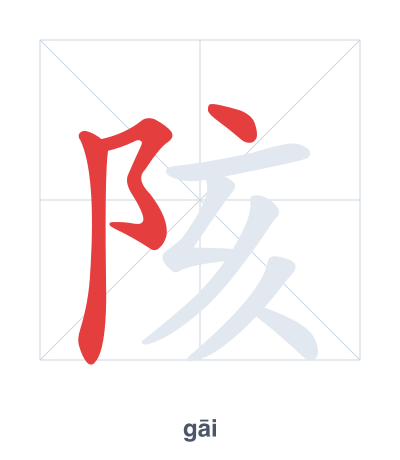
Stroke order practice for 陔 - gāi

Practice Writing 陔 (gāi)

Open Hanzi Writer to see the animated stroke order and practice writing 陔 with real-time feedback.

The character (gāi) is written with 8 strokes. Follow the standard Chinese stroke order: top to bottom, left to right, outside before inside. The radical is one of its key components.

Practice the correct stroke order with the Hanzi Writer app to see animated stroke-by-stroke guidance with real-time feedback.

means step or terrace.

Character
Pinyingāi (gai)
Meaningstep or terrace
Strokes8
Radical
Difficulty3.4/5

陔 combines the radical 阝 (representing a hill or mound) with 亥, which originally served a phonetic role, to depict a terrace or step carved into a hillside.

💡 Memory Tip: Picture a pig (亥) climbing a stone step on a hill (阝) under the moonlight.

jiǔ gāi
Jiugai (the nine heavens; a very high place)
gāi xià
Gaixia (ancient ritual music)
gāi yǐ
Gaiyi (ancient term)

九陔指极高的地方。

jiǔ gāi zhǐ jí gāo de dì fāng

Jiugai refers to a very high place.

陔夏是古代的乐章。

gāi xià shì gǔ dài de yuè zhāng

Gaixia is an ancient musical movement.

陔以是古书中的词语。

gāi yǐ shì gǔ shū zhōng de cí yǔ

'Gaiyi' is a term found in ancient books.

Character Pinyin Strokes Radical
(current) gāi 8
bīn 6
fāng 6
xíng 6
Stroke order practice for 陔 - gāi

Practice Writing 陔 (gāi)

Open Hanzi Writer to see the animated stroke order and practice writing 陔 with real-time feedback.

✨ Animated stroke order · Handwriting recognition · HSK-graded practice · Free to use

Frequently Asked Questions about 陔

陔 is composed of the radical 阝 (left ear, meaning a hill or mound) on the left, and the phonetic component 亥 (hài) on the right. The left part indicates a raised area like a step or terrace, while 亥 provides the pronunciation gāi.

Characters with Radical 阝

Other 8-Stroke Characters