茯 (fú) means "poria" in Chinese. It has 9 strokes with the radical 艹.
Rated 4/5 in difficulty (challenging).
Appears in 3+ common words including 茯苓 (fú líng), 茯茶 (fú chá), 茯苓饼 (fú líng bǐng).
Due to its 9 strokes, Hanzi Writer's error detection shows 茯 requires focused practice — most learners need 10+ attempts for consistent accuracy.
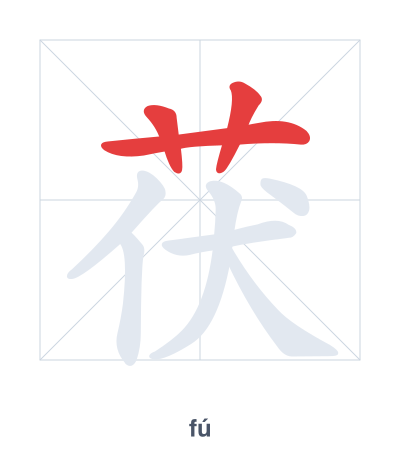
Open Hanzi Writer to see the animated stroke order and practice writing 茯 with real-time feedback.
The character 茯 (fú) is written with 9 strokes. Follow the standard Chinese stroke order: top to bottom, left to right, outside before inside. The radical 艹 is one of its key components.
Practice the correct stroke order with the Hanzi Writer app to see animated stroke-by-stroke guidance with real-time feedback.
茯 means poria.
茯 is a phono-semantic compound with the radical 艹 (grass) indicating it is a plant or fungus, and the phonetic component 伏 (fú, meaning 'to lie down') hinting at how poria clings low to tree roots underground.
💡 Memory Tip: Picture a dog (犬) lying down (亻) under grass (艹), like a hidden poria fungus growing beneath the earth.
茯苓是一种中药。
fú líng shì yī zhǒng zhōng yào
Poria is a type of traditional Chinese medicine.
爷爷爱喝茯茶。
yé yé ài hē fú chá
Grandpa loves drinking Fu tea.
这是北京特产茯苓饼。
zhè shì běi jīng tè chǎn fú líng bǐng
This is the Beijing specialty, Poria cake.
Open Hanzi Writer to see the animated stroke order and practice writing 茯 with real-time feedback.
✨ Animated stroke order · Handwriting recognition · HSK-graded practice · Free to use
茯 is composed of the grass radical 艹 on top and the phonetic component 伏 (fú) below. The grass radical indicates it is a plant or fungus, and 伏 provides the pronunciation. This structure shows that 茯 is a type of fungus that grows on plant roots, specifically poria.