苓 (líng) means "fungus / poria" in Chinese. It has 8 strokes with the radical 艹.
Rated 3.7/5 in difficulty (challenging).
Appears in 3+ common words including 茯苓 (fú líng), 茯苓膏 (fú líng gāo), 甘苓 (gān líng).
Due to its 8 strokes, Hanzi Writer's error detection shows 苓 requires focused practice — most learners need 10+ attempts for consistent accuracy.
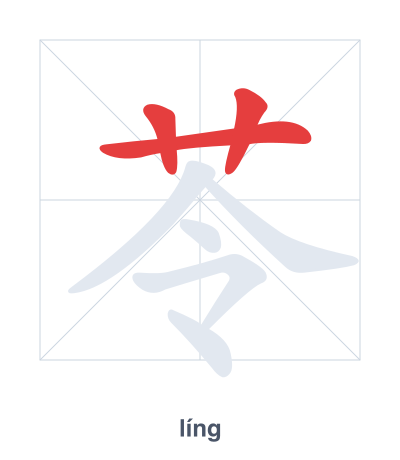
Open Hanzi Writer to see the animated stroke order and practice writing 苓 with real-time feedback.
The character 苓 (líng) is written with 8 strokes. Follow the standard Chinese stroke order: top to bottom, left to right, outside before inside. The radical 艹 is one of its key components.
Practice the correct stroke order with the Hanzi Writer app to see animated stroke-by-stroke guidance with real-time feedback.
苓 means fungus / poria.
苓 is a phono-semantic compound: the radical 艹 (grass) signals it's a plant-like fungus, while 令 (líng) provides the pronunciation. It originally referred to a medicinal fungus such as poria cocos that grows on tree roots, hence the 'grass' component indicating a plant-based organism.
💡 Memory Tip: Imagine a tiny bell (令) made of fungus poking out from under a patch of grass (艹).
茯苓是一味中药。
fú líng shì yī wèi zhōng yào
Poria is a traditional Chinese medicine.
我想吃茯苓膏。
wǒ xiǎng chī fú líng gāo
I want to eat Poria jelly.
甘苓可以入药。
gān líng kě yǐ rù yào
Ganling can be used as medicine.
Open Hanzi Writer to see the animated stroke order and practice writing 苓 with real-time feedback.
✨ Animated stroke order · Handwriting recognition · HSK-graded practice · Free to use
The character 苓 is made of two parts: the top radical 艹 (grass) and the bottom part 令 (líng, meaning 'order'). The grass radical indicates it is a plant or herb, while 令 gives the pronunciation. Together, they form a word for a type of fungus or medicinal herb, specifically poria.